
Performance Marketing in Pune: How to Generate Quality Leads & Sales with Google Ads and Meta Ads
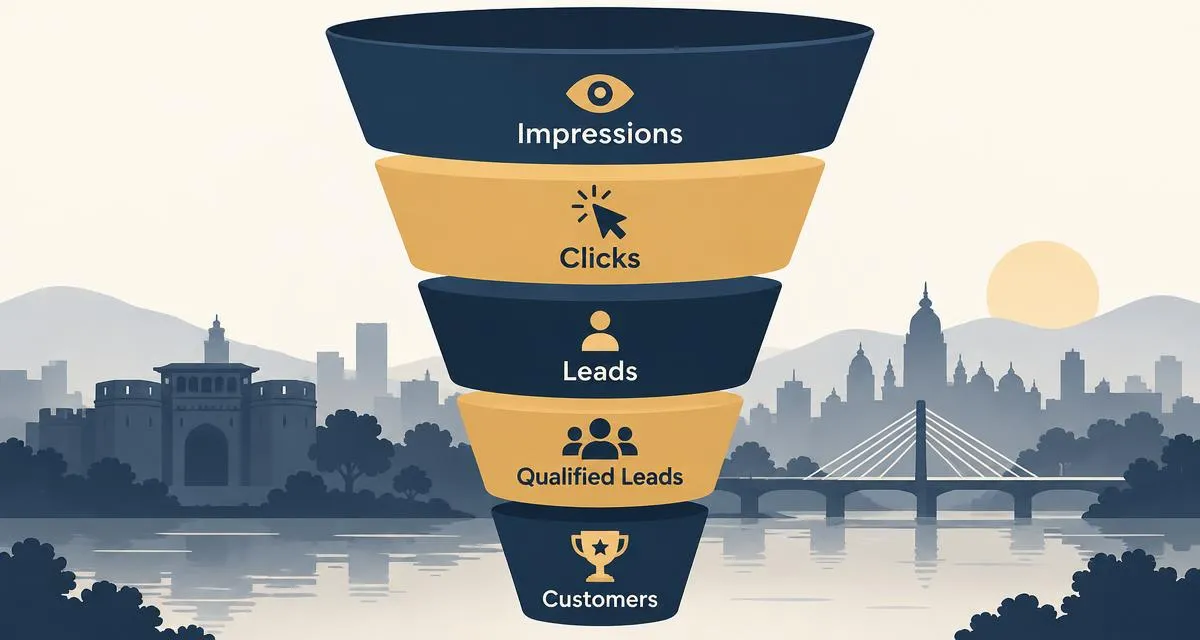
Performance Marketing PuneGoogle Ads PuneMeta Ads PuneFacebook Ads PuneInstagram Ads PuneLead Generation PuneConversion Tracking
How to Get Recommended by AI Search
A practical, no-guarantees guide to building the clarity, expertise, content, authority and technical access that support discovery across search and AI answers.
Google Ads and AI Search in 2026
AI Search is changing how people express intent and how Google Ads interprets it. A practical guide to campaigns, landing pages, conversion data and qualified growth.
Conversion Tracking for Google Ads & Meta Ads
Most accounts can report lead volume. Very few can say which campaigns produced customers. Here is how to connect ad clicks, leads, qualified leads and revenue.
I run these campaigns for startups, e-commerce brands and local businesses from Pune — across India and the GCC.
Google Ads consultant in Pune
Search, Shopping and PMax managed for qualified leads.
Meta Ads consultant in Pune
Facebook and Instagram campaigns built around offer and creative.
Performance marketing consultant in Pune
Strategy, execution and measurement under one owner.
Google Ads lead generation
Lower cost per qualified lead, not just cheaper clicks.
Conversion tracking consultant in Pune
GA4, GTM, Meta CAPI and offline conversion imports.
Let's discuss your goals & create a winning strategy for your business.
Performance marketing is a data-driven approach to digital advertising where campaigns are planned, measured and optimised around specific business outcomes such as qualified leads, enquiries, sales and revenue. Businesses can use Google Ads to reach people actively searching for solutions and Meta Ads to discover and engage potential customers on Facebook and Instagram.
Most Pune business owners don't have a problem getting ads to run. The problem is knowing whether those ads are producing customers. A campaign can show thousands of impressions and hundreds of clicks and still leave the sales team with a list of wrong numbers, students looking for jobs, or people outside your service area.
Performance marketing fixes that by starting from the outcome you need — admissions, site visits, appointments, orders — and working backwards. Every campaign, keyword, audience and creative is judged on whether it moves people towards that outcome at a cost the business can sustain.
This guide is written by Nikhil Khachane, an independent performance marketing consultant based in Pune. It explains how Google Ads and Meta Ads work for local businesses, how to improve lead quality, and how to measure results honestly. It does not promise a particular number of leads, because no honest marketer can.
Traditional advertising buys attention. Performance marketing buys — and measures — actions. The basic chain looks like this:
Your ad is shown to someone in Pune who matches your targeting.
They tap the ad, visit your landing page, call, or open WhatsApp.
They leave their details, call you or send a message.
Your team confirms the person has a genuine need, budget and fit.
The lead becomes a sale, admission, booking or order.
Along that chain you watch a handful of numbers: click-through rate (how many people who see the ad click it), cost per lead, conversion rate, customer acquisition cost (what it costs to win one customer) and return on ad spend (revenue divided by ad spend). The point is not to make each number look good on its own, but to make the whole chain profitable. For a deeper look at building that chain, see this guide to building a profitable performance marketing funnel.
Pune is not one market. A campaign that works for a coaching institute will look very different from one for an industrial supplier or a dental clinic. Some of the business types that commonly advertise online in and around the city:
What this means in practice: location targeting, keyword choice and the offer must reflect how your customers buy. A clinic may only want patients within a few kilometres; a manufacturer may want buyers across Maharashtra; an e-commerce brand may want all of India. Getting this wrong is a common cause of wasted budget.
Google Ads can be a strong starting point when potential customers are actively searching for a product or service. It helps businesses connect with people who already show intent through their searches — for example "physiotherapist near Aundh" or "GST consultant Pune".
Start with Search campaigns built around keywords that signal a decision — the service plus a location, "near me", "cost", "book" or "best". Group keywords tightly by service so each ad and landing page can match the search closely.
Location targeting should reflect where a business can genuinely acquire and serve customers, and that depends on the business model:
Radius, city and locality targeting are tools to choose according to the business, not defaults. In most cases, set the location option to people in or regularly in the target areas rather than people merely interested in them. The guide to Google Ads for local businesses in India covers radius, pin-code and service-area strategies in more detail.
Broad keywords can bring in searches for jobs, free courses, DIY tips and competitors' names. Review the search terms report regularly and add negatives such as "jobs", "salary", "free", "course" or "internship" where they don't fit your offer. This is one of the most practical ways to reduce spend on irrelevant searches and keep optimisation focused on real prospects.
The landing page should repeat the promise of the ad, load quickly on mobile, show the phone number and WhatsApp button without scrolling, and ask for one clear action. A generic homepage rarely converts as well as a page built for one service.
Measure form submissions, calls from ads, calls from the website, WhatsApp clicks and, where possible, actual business outcomes such as qualified leads or sales. The setup should distinguish meaningful conversions from low-value interactions such as page views or button taps; otherwise automated bidding optimises towards the wrong signal. This foundation is covered in the conversion tracking guide for Google Ads and Meta Ads.
If you'd like hands-on help with this, see Google Ads consulting and management in Pune.
Meta Ads covers Facebook and Instagram, including Reels, Stories and the main feeds. Instead of waiting for a search, it puts your offer in front of people likely to be interested, which makes it useful for launches, admissions, events, real estate, fitness, restaurants and e-commerce.
Broader audiences combined with Meta's automated delivery can work well in suitable campaigns, especially when there is enough conversion data for the system to learn from. They are not automatically better, though. The right targeting depends on the campaign objective, the conversion data available, the likely audience size, the product or service and the geographic coverage — a locality-focused clinic and a state-wide admissions campaign need different set-ups. Custom audiences from website visitors and customer lists are often more useful than stacking many interests.
On Meta, the creative carries much of the targeting work. Use original creatives that show the real product, place or people; lead with a specific benefit; and test genuinely different concepts and angles — price, convenience, trust, urgency — rather than minor colour or wording changes. Short vertical video tends to suit Reels and Stories.
Instant forms are convenient but make it easy to submit by accident. Use the "higher intent" form type, add one or two qualifying questions and consider sending people to WhatsApp or a landing page when you need more serious enquiries. More on this in the Meta Ads lead generation guide for India.
A form submission is not the same as a qualified lead. Sending qualified-lead or sale events back to Meta is not automatic: it usually requires CRM integration, correctly configured conversion events and the Meta Conversions API. Once that is set up, Meta's delivery can use those signals instead of raw form fills.
Many people need several touches before they enquire. Retarget website visitors, video viewers, previous enquiries and people who engaged but didn't convert with reminders, testimonials you genuinely have, FAQs or a time-bound offer.
Prompt follow-up can improve the chances of connecting with interested leads. Businesses should establish a clear process to contact, qualify and track enquiries. If lead quality is the main concern, read why Meta Ads leads are often poor quality and how to fix it, or see Meta Ads consulting for Facebook and Instagram in Pune.
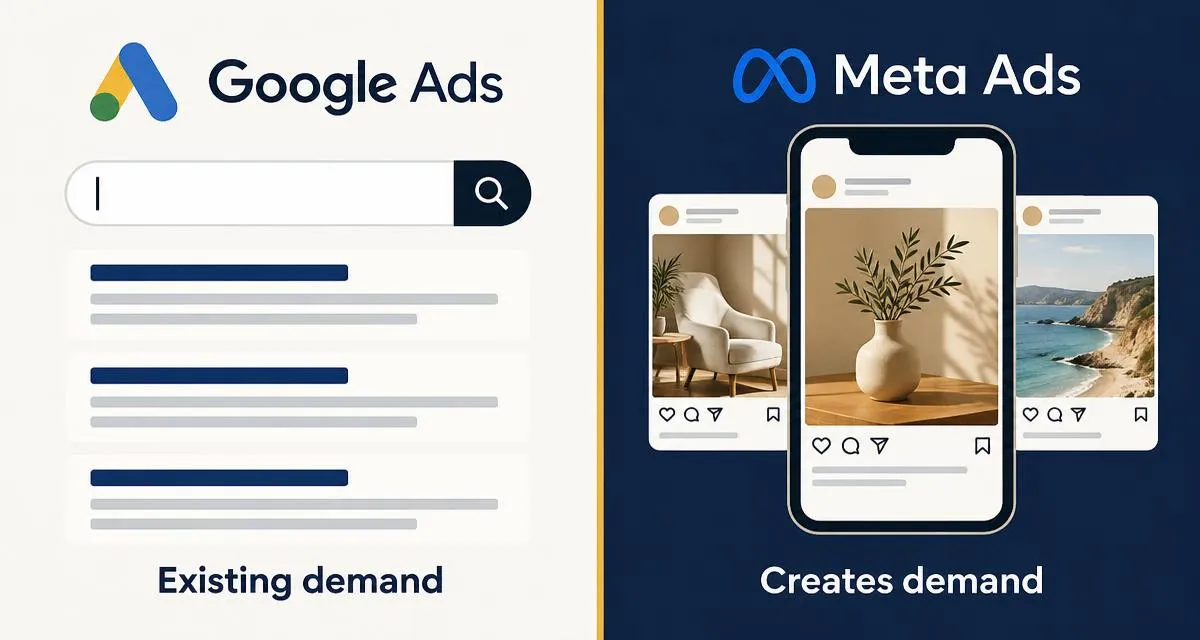
Short answer: neither platform is universally better. Google Ads works on search intent and captures demand that already exists; Meta Ads works on audience discovery and helps create demand. Businesses can use Google Ads, Meta Ads or both depending on their objectives, audience, offer, sales cycle and available budget.
On Google, keywords decide who sees the ad; on Meta, the audience settings and creative do. That changes the conversion journey too: a Google searcher often calls or fills a form in one visit, while a Meta user may need several touchpoints and retargeting before enquiring. Lead quality on either platform depends on targeting, the offer and how enquiries are qualified.
| Factor | Google Ads | Meta Ads |
|---|---|---|
| User intent | Search intent: the person is actively looking for a product or service | Audience discovery: the person is browsing, and a relevant ad introduces your offer |
| Demand | Captures demand that already exists ("dentist in Baner", "CA for GST Pune") | Helps create demand among people who haven't searched yet |
| Targeting | Keywords, match types, location, device and schedule | Audiences, location and, above all, the creative and offer |
| Lead quality | Often higher intent, but depends on keyword choice and negative keywords | Can be mixed; improves with qualifying questions, clear offers and follow-up |
| Creative | Text ads, assets and landing page relevance | Images, video, Reels and Stories carry most of the weight |
| Conversion journey | Search → ad → landing page, call or WhatsApp | Feed → ad → instant form, WhatsApp or website, often over several touchpoints |
| Retargeting | Remarketing lists across Search, Display and YouTube | Retargeting website visitors, video viewers and engaged users on Facebook and Instagram |
Google Ads and Meta Ads are trademarks of their respective owners; AdsWithNikhil is independent and not affiliated with or endorsed by Google or Meta. For the full breakdown, read Google Ads vs Meta Ads for lead generation in India.
A hundred leads that don't answer the phone are worth less than ten that do. Quality is shaped at every step, not just in the ad account.
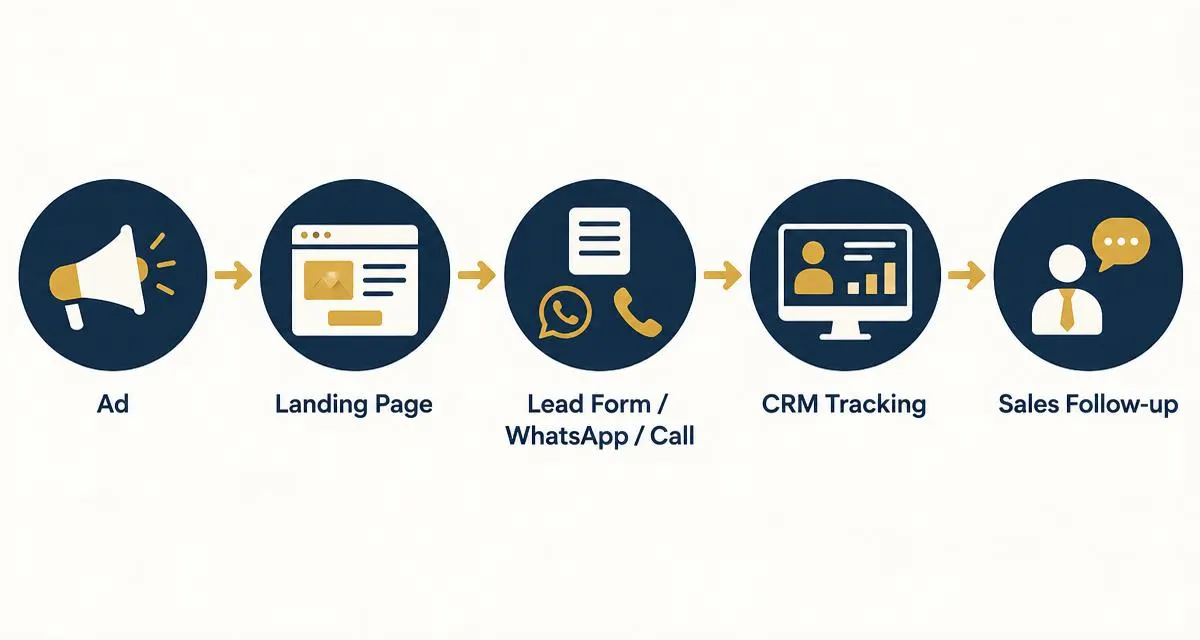
Be specific about who it's for, what it costs (or a range), and where you serve. Clear qualifiers in the ad discourage the wrong people from enquiring.
One page per service, matching the ad, with proof you genuinely have, a short form and visible phone and WhatsApp options.
Ask only what you need, but include one or two questions that separate serious buyers — timeline, location, budget range or requirement.
Many Pune customers prefer to call or message. Track these as conversions and make sure someone responds quickly during ad hours.
Record every lead's source, status and outcome — even in a simple shared sheet. Without this you cannot tell which campaign produced customers.
Agree a response time, a script and a follow-up sequence. Good campaigns are often blamed for slow follow-up.
Qualified lead vs low-quality enquiry: a qualified lead has a real need, is in your service area, has a realistic budget and responds. A low-quality enquiry is a wrong number, a job seeker, a student researching, or someone who doesn't remember submitting the form. Mark each lead accordingly and feed that status back to the ad platforms. The article "Getting 100 leads isn't success" explains how to optimise Google Ads for revenue instead of lead volume.
Measure from the ad all the way to revenue. These are the numbers worth reviewing:
Illustration only: Campaign A produces leads at a low cost per lead, but very few become customers. Campaign B costs several times more per lead, but a much larger share convert. Campaign B can easily have the lower cost per customer and the higher profit — yet a report that only shows cost per lead would tell you to cut it. This is why cheap leads can be more expensive and why measurement should continue past the form. A step-by-step approach is in measuring performance marketing from ad clicks to revenue.
Whether you hire a freelancer, a consultant or an agency, look for evidence of how they work rather than promises of results.
Management fees and recommended ad spend depend on each business's scope, goals, competition, campaign complexity and requirements, so be cautious of anyone quoting a fixed package before understanding your business. AdsWithNikhil is a Pune-based performance marketing consultancy offering online advertising consulting and campaign management services to businesses. You can see how it approaches campaigns on the performance marketing services in Pune page.
Performance marketing in Pune is paid advertising, mainly Google Ads and Meta Ads, planned and judged on measurable business outcomes such as calls, enquiries, qualified leads, sales and revenue rather than reach alone. For Pune businesses it means targeting the areas they genuinely serve, tracking conversions accurately and optimising campaigns based on which leads become customers.
Look for someone who can explain their relevant campaign experience, how they set up conversion tracking and how they report on qualified leads and revenue rather than only clicks. Ask who owns the ad accounts, how lead quality will be measured and how often you will receive reports. A short audit or discovery call is a practical way to judge their approach before committing.
Google Ads shows ads to people who are searching for what you offer, so it mainly captures existing demand. Meta Ads shows ads on Facebook and Instagram to people based on audience signals and the creative, so it helps create demand among people who were not actively searching.
Neither platform is better for every business. Google Ads often suits urgent or high-intent services such as clinics, repairs and professional services. Meta Ads often suits visual, offer-led or new products such as real estate launches, admissions, fitness and e-commerce. Many businesses use both, depending on their objectives, audience, offer, sales cycle and budget.
Yes, when the basics are in place: a clear offer, a defined service area, a landing page or WhatsApp flow that converts, and a process for responding to enquiries. Small businesses can start with tightly focused campaigns and expand only when tracking shows which campaigns produce real customers. The right budget depends on goals, competition and capacity.
Focus on high-intent keywords, review the search terms report regularly and add relevant negative keywords, target only the locations you can genuinely serve, send traffic to a matching landing page, and track calls, forms and WhatsApp clicks as conversions. Where possible, import qualified-lead or sale data so bidding can optimise towards meaningful outcomes.
Use higher-intent lead forms with qualifying questions, state eligibility or price ranges clearly in the ad, and follow up promptly. Sending qualified-lead or sale events back to Meta can help delivery, but it is not automatic: it requires a correctly configured CRM integration, appropriate conversion events and usually the Meta Conversions API.
Track each lead from its source through to a sale in a CRM or shared sheet, then compare revenue or gross profit from ad-sourced customers with total ad spend and management cost. Cost per lead alone is not ROI; cost per qualified lead, customer acquisition cost and revenue give a more reliable view of profitability.
Performance marketing is about measurable business outcomes — qualified leads, sales and revenue — not just clicks and impressions. Google Ads and Meta Ads have different strengths: one captures people already searching, the other reaches people who haven't searched yet. The right mix depends on your business model and objectives, and neither works well without accurate tracking and consistent follow-up.
AdsWithNikhil is a Pune-based performance marketing consultancy run by Nikhil Khachane, offering its services online. If you'd like to discuss your advertising requirements, explore performance marketing services, Google Ads management or Meta Ads management, or request a free 10-minute paid ads audit. Fees and ad spend are discussed once your scope and goals are clear.