
Blindly enable every AI feature
Automation is a set of choices, not a maturity badge. Test the settings that solve a defined problem.
Search is becoming conversational, multimodal and more automated. The useful question is not whether AI is coming to Google Ads, but whether your campaigns, pages and conversion data are ready to make better decisions with it.
Written by Nikhil Khachane, Performance Marketer at AdsWithNikhil · Published September 17, 2026 · 16 min read
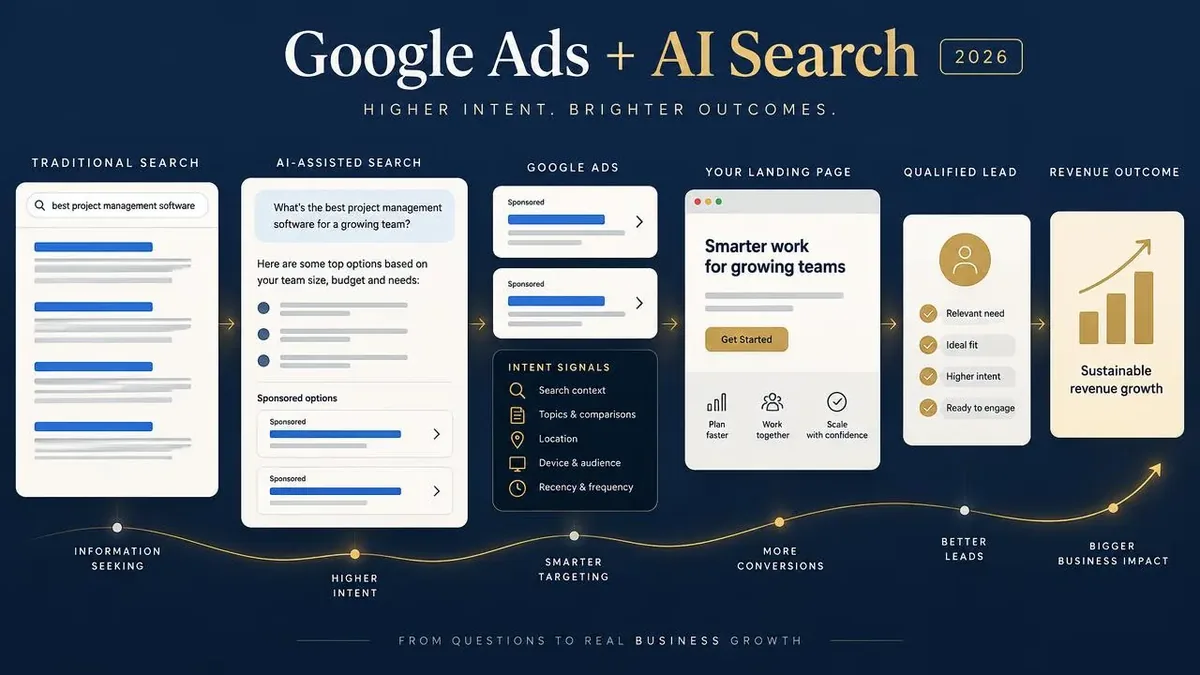
What does the rise of AI Search mean for your Google Ads campaigns? It means people can express intent through longer questions, follow-ups, voice and images, while Google has more context to decide which ad, message and landing page may be useful. Your keyword list still matters, but it is no longer enough to explain the complete customer journey.
That changes the work. A tightly organised account with weak sales data can now automate the wrong outcome faster. A business with clear offers, useful pages and a reliable feedback loop can give both people and bidding systems better information.
This guide separates product facts from strategy. Google decides how its search and advertising products work; the recommendations below are AdsWithNikhil’s interpretation of what those changes mean for a business trying to acquire profitable customers.
AI Search adds generated answers and conversational exploration to the familiar mix of organic results and paid placements. It does not mean every search becomes an AI answer or that traditional results disappear.
Google’s official material describes AI Overviews as summaries that help people understand a topic and explore sources. Ads can appear around, and in eligible markets within, these experiences when relevant. Google has also been developing ad experiences for AI Mode, where people can ask a complex question and continue with follow-ups. Product availability, formats and country coverage change, so advertisers should verify what is available in their own account rather than planning around a screenshot from another market.
| Search layer | What the person sees | Role for a business | What improves relevance |
|---|---|---|---|
| Organic search | Pages selected by ranking systems | Earn visibility by being useful, accessible and relevant | Helpful pages, authority, technical access |
| Paid search | Sponsored placements triggered by relevance and auction signals | Reach demand while it is active | Intent, ad relevance, bidding and conversion data |
| AI-assisted search | Generated answers, summaries and follow-up exploration | Help people research and decide across a longer journey | Clear entities, evidence, useful content and relevance |
The distinction matters. Organic visibility is earned. Paid visibility is auction-based. AI-generated answers are assembled by Google’s systems. One page can support all three by being technically accessible, commercially clear and genuinely helpful, but no page is entitled to appear in an AI answer.
Search is moving from short phrases toward richer expressions of context. People can explain their situation, refine an answer, upload an image or speak naturally instead of translating a problem into two or three keywords.
Consider a Pune coaching business owner asking: “I run a coaching business in Pune and need 30 qualified leads a month. Should I use Google Ads or Meta Ads?” That is not one keyword. It contains a business model, location, desired outcome, channel comparison and an implied concern about lead quality. A useful answer has to address all of them.
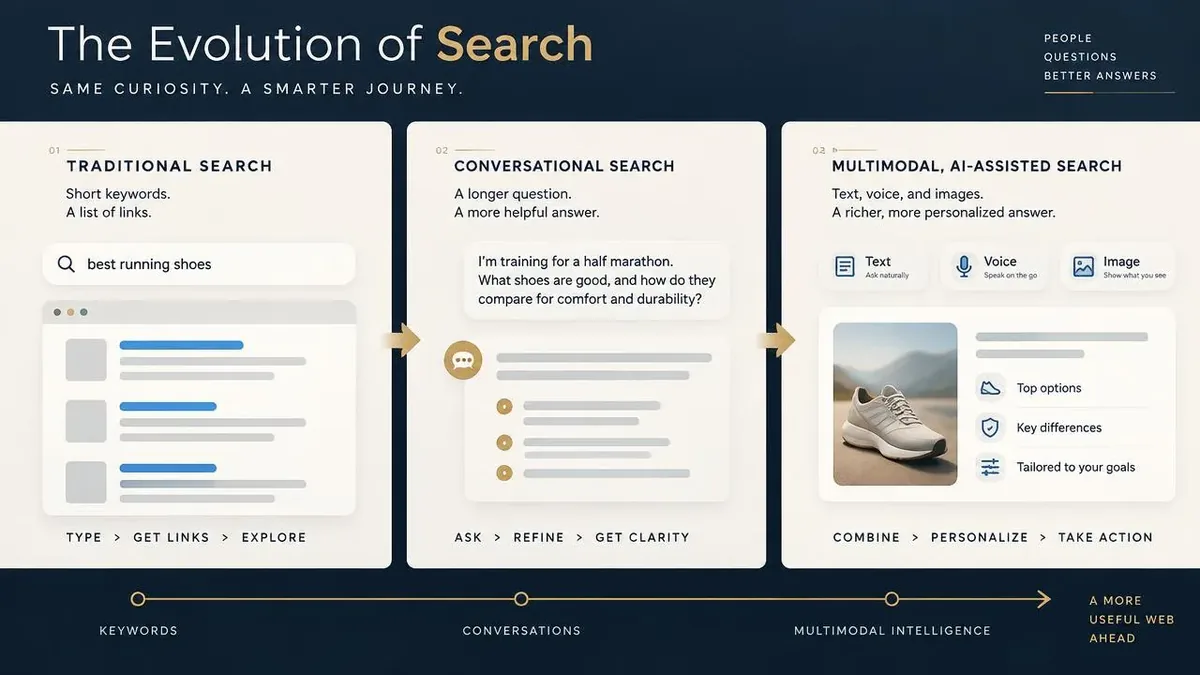
This does not remove commercial search. Someone may research a problem through AI, compare options through organic articles, see Meta creative, and later search a provider by name. The final Google Ads click may capture the decision without having created all the demand behind it. That is why the broader Google Ads versus Meta Ads customer journey matters when interpreting attribution.
AI Max is an optimisation layer within an existing Search campaign—not a new campaign type and not Performance Max. Google says it combines expanded search-term matching with asset optimisation and additional controls and reporting.
| Feature | What it does | What the advertiser must review |
|---|---|---|
| Search-term matching | Uses broad match and keywordless technology to reach relevant queries beyond the literal keyword list. | Search-term quality and negative keywords |
| Text customization | Can generate or adapt headlines and descriptions from ads, keywords and relevant website content. | Accuracy, tone and brand suitability |
| Final URL expansion | Can select another relevant page on the same domain when the setting is enabled. | Landing-page report and URL exclusions |
| Smart Bidding | Uses auction-time signals to bid toward the conversion goal or value supplied by the advertiser. | Primary goals, values and business outcomes |
| Reporting and controls | Adds views into search terms, assets, landing pages and combinations used. | Patterns over a meaningful test window |
The practical trade-off is wider interpretation in exchange for less manual certainty. Search-term matching can use broad match and keywordless technology to find relevant queries beyond the exact keyword list. Text customization can adapt message elements using campaign and website inputs. Final URL expansion can choose another relevant page on your domain when enabled. Smart Bidding responds to auction-time signals, but only toward the objective you have configured.
These controls should be considered separately. Enabling a suite does not remove your responsibility for negative keywords, locations, brand controls, URL exclusions, search-term reviews or conversion goals. New Search campaigns may present AI Max as selected by default, while legacy text-customization settings are changing during 2026; check the actual campaign settings before assuming the account is unchanged.
For detailed setup, risks and testing criteria, use the dedicated Google Ads AI Max guide for 2026. This article stays focused on the wider change in search behaviour and measurement.
Yes. Keywords still organise demand and provide control, but the same keyword can hide several different intentions. AI systems are getting better at interpreting context around the words; advertisers still need to decide which contexts are commercially useful.
Take “Google Ads agency Pune.” It looks like one high-intent phrase, but the person may be ready to hire, comparing a consultant with an agency, researching fees, seeking a job, looking for training, or troubleshooting an account. The phrase is only the door. The underlying task determines whether a click is valuable.
| Underlying intent | Example query | What the page needs to answer |
|---|---|---|
| Find a provider | Google Ads agency Pune | Service fit, location, proof, contact |
| Compare options | Google Ads consultant vs agency | Working model, accountability, pricing approach |
| Solve a problem | Why are my Google Ads leads poor quality? | Diagnosis, tracking, search terms, qualification |
| Learn before buying | How much budget does Google Ads need? | Demand, CPC, conversion rate and sales economics |
| Evaluate a feature | Should a small business use AI Max? | Readiness, control, data volume and risk |
| Measure an outcome | How do I track Google Ads leads to sales? | CRM stages, imports, values and attribution |
This is why search-term reports, negative keywords and landing-page alignment remain essential. AI can infer more, but it can also explore into adjacent intent. Your job shifts from building exhaustive keyword lists toward defining commercial boundaries and verifying the traffic that crosses them.
For a local advertiser, those boundaries also include geography and serviceability. The local Google Ads guide for Indian businesses explains how location settings, local intent and page relevance work together.
Automation amplifies the conversion definition you give it. If every form submission is called success, the campaign has no reason to distinguish a serious buyer from a fake number, a student, a job seeker or someone outside your service area.
A low CPL can therefore become an expensive operational problem. Sales spends time calling people who never answer. Reports look efficient while the opportunity pipeline stays empty. Budget moves toward queries and pages that produce forms rather than customers.
The better hierarchy is: lead → contacted lead → qualified lead → opportunity → customer → revenue → profit. Your account may not be ready to optimise at the final stage immediately, but reporting should move closer to money as the data improves.
This is the core argument in optimising Google Ads for profit rather than lead volume. It also explains why advertising can appear healthy while the business is not growing after the click.
Conversion data is the feedback that tells automated bidding what kind of demand the business values. Better matching without better feedback can simply find more of the wrong outcome.
| Stage | What it confirms | How to use it |
|---|---|---|
| Lead submitted | A contact action happened | Useful operationally, but not proof of quality |
| Contacted | The person answered or responded | Separates real contacts from unreachable enquiries |
| Qualified | Need, fit, location, budget or timing matched | A stronger bidding and reporting signal |
| Appointment / opportunity | A genuine commercial conversation began | Connects marketing with the sales pipeline |
| Proposal | The business invested sales effort | Shows progression, not yet revenue |
| Sale | The lead became a customer | The clearest outcome for acquisition decisions |
| Revenue / profit | The customer created financial value | Lets budget follow value rather than volume |
A practical lead flow might be: submitted → contacted → qualified → appointment → proposal → sale. The website records the first action; the CRM or a disciplined sales system records the rest. Enhanced conversions can improve measurement using consented first-party data, and Google’s current workflows support bringing offline outcomes back through its data tools. Implementation details changed during 2026, so follow current Google documentation rather than an older tutorial.
Each stage should have a clear definition. “Qualified” might mean the prospect is in a serviceable location, has the right need, meets the budget threshold and expects to decide within a realistic period. Without that shared rule, sales feedback is subjective and the imported signal becomes noisy.
The conversion tracking guide from click to sale covers primary and secondary conversions, CRM stages, enhanced conversions and offline outcomes in detail.
Your landing page is now both a sales experience and an important source of context. It helps a person decide, helps search systems understand the offer and can influence ad text or destination selection when automated features are enabled.
An AI-ready landing page should make these facts easy to verify:
Do not send every query to the homepage. Someone researching Google Ads conversion tracking needs a different answer from someone seeking local lead generation. A relevant page reduces ambiguity between ad intent, page promise, conversion and business outcome.
They are connected through the customer’s research journey and the quality of the website, but they remain different disciplines.
For a broader business-discovery strategy beyond paid media, use the practical guide to AI Search Optimization across Google, ChatGPT and Gemini. It covers business identity, topical authority, third-party evidence, local relevance and technical access without promising an AI recommendation.
A strong article can answer an early question. A service page can explain fit. A paid ad can capture active demand. Conversion tracking can show which path produced a qualified customer. These parts reinforce one another, but GEO does not guarantee a citation and SEO does not buy ad placement.
For AdsWithNikhil, that means keeping a clear identity—Nikhil Khachane, a performance marketer based in Pune—and publishing practical material around Google Ads, Meta Ads, lead quality, conversion tracking and profitable growth rather than creating disconnected pages for every variation of a keyword.
Prepare by improving the system around the campaign before increasing automation. This checklist is useful whether the business serves Pune, sells across India or runs a longer B2B sales cycle.
Small businesses should be especially disciplined. A limited budget cannot support every campaign type, every location and every conversion goal at once. Concentrate data in the part of the funnel that already has demand, then add automation or channels when measurement can explain the result.
The framework connects customer intent to profit and sends the business result back into optimisation. It prevents the ad account from becoming a closed dashboard that celebrates activity without understanding value.
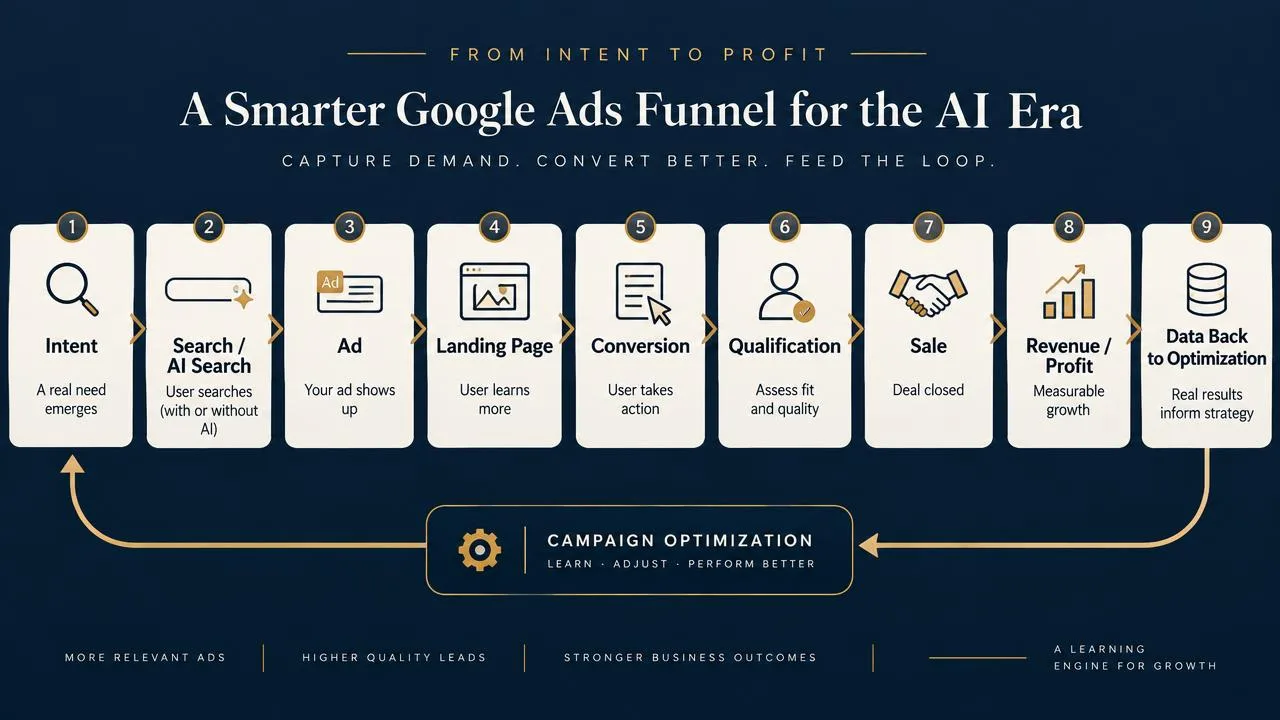
A real need exists: urgent, exploratory, comparative or problem-led.
The person expresses that need through keywords, a longer question, voice or an image.
A relevant sponsored message earns attention without overstating the offer.
The page confirms fit, answers the question and gives a clear next action.
A call, form, booking or purchase is recorded accurately.
The business checks whether the enquiry is serviceable and commercially relevant.
Follow-up and the offer turn the opportunity into a customer.
The business records the value that survived delivery costs and sales effort.
Qualified and closed outcomes return to reporting and bidding, improving the next decision.
The first four stages determine relevance. The middle stages determine lead and sales quality. The final stages determine whether the acquisition was economically useful. The feedback loop then gives campaign decisions something better than a form count to learn from.
This sits alongside the broader Ad-to-Revenue performance marketing funnel: both make the same distinction between generating activity and generating profitable growth.
Do not replace strategy with settings. The safest response to a fast-moving product is a stronger measurement discipline, not a rush to enable everything.
Automation is a set of choices, not a maturity badge. Test the settings that solve a defined problem.
Keywords still reveal language, commercial categories, competition and negative themes.
Low CPL can reward people who never answer, qualify or buy.
A persuasive ad can earn clicks from the wrong people. Measure what happens after the click.
AI cannot make a broad page answer every specific need. Match intent to a focused page.
Broader matching still needs search-term reviews, exclusions and negatives.
A fast draft that is inaccurate, generic or unsupported weakens trust and gives customers little reason to choose you.
People still need sources, comparisons, websites and actions. Build for the full journey rather than one result format.
Vendor benchmarks and account-specific outcomes are not promises. Use your own verified business data.
Google Ads in 2026 is not a choice between manual control and blind automation. It is a shift toward supplying better context, better pages and better business signals while retaining deliberate controls around relevance and risk.
If people can describe their needs more naturally, your content should answer more clearly. If Google can match beyond a keyword, your negatives and search-term reviews should define the boundary. If bidding can optimise in real time, your conversion data should represent a qualified opportunity or customer rather than the cheapest form submission.
The durable advantage is not access to the same AI feature every advertiser receives. It is knowing which customers are profitable, recording that outcome and feeding it back into the system.
AI Search is a search experience that uses generative AI to interpret a question, combine information and present a structured answer. On Google, AI Overviews and AI Mode can support longer, conversational and follow-up queries. They add to traditional results rather than making every search page or blue link disappear.
Google changes Search experiences, eligibility and campaign controls frequently. This article was reviewed against official information available on September 17, 2026. Confirm current settings and availability in your account before making changes.
If you are running Google Ads but measuring success mainly by leads rather than qualified opportunities, start by reviewing how the campaigns, tracking and sales data connect.
Get a Free 10-Minute Paid Ads AuditHow to Get Recommended by AI Search
A practical, no-guarantees guide to building the clarity, expertise, content, authority and technical access that support discovery across search and AI answers.
Conversion Tracking for Google Ads & Meta Ads
Most accounts can report lead volume. Very few can say which campaigns produced customers. Here is how to connect ad clicks, leads, qualified leads and revenue.
Ads Working But Business Not Growing?
Clicks, leads and a healthy cost per lead — and flat revenue. The Ad-to-Growth Framework and the ten places business growth actually breaks after the click.
I run these campaigns for startups, e-commerce brands and local businesses from Pune — across India and the GCC.
Google Ads consultant in Pune
Search, Shopping and PMax managed for qualified leads.
Meta Ads consultant in Pune
Facebook and Instagram campaigns built around offer and creative.
Performance marketing consultant in Pune
Strategy, execution and measurement under one owner.
Google Ads lead generation
Lower cost per qualified lead, not just cheaper clicks.
Conversion tracking consultant in Pune
GA4, GTM, Meta CAPI and offline conversion imports.
Let's discuss your goals & create a winning strategy for your business.