
Why Cheap Leads Can Be More Expensive Than Expensive Leads
A ₹100 lead that never becomes a customer costs more than a ₹500 lead that does. The truth about lead quality, acquisition cost and revenue.
By Nikhil Khachane · Performance marketer · 12 min read
If one campaign gives you leads at ₹100 and another gives you leads at ₹500, which one is performing better?
Almost everyone picks the ₹100 campaign. It is the obvious answer, and it is the answer the dashboard encourages.
But what if those cheap leads never answer the phone, have no budget, and are located somewhere you do not operate? And what if the ₹500 leads pick up on the first call, know what they want, and buy at a steady rate?
Then which campaign is actually cheaper?
Quick answer: Cheap leads become expensive when they consume sales time, follow-up effort and tooling without producing customers. The cost of a lead is not the cost of acquiring a customer. Measure cost per qualified lead, lead-to-sale rate and customer acquisition cost — a higher CPL with better conversion is frequently the cheaper campaign.
This is the single most expensive misunderstanding in paid advertising. Cost per lead is the easiest metric to improve and the easiest to improve in the wrong direction, because almost every action that lowers it — broader targeting, a softer offer, a shorter form — also lowers the intent of the person on the other side.
Cheap leads can create an expensive business problem
A lead does not stop costing money the moment it arrives. That is where its cost starts.
Every lead entering your business consumes resources that never appear in your ad account:
- Sales team time spent calling, messaging and re-calling
- Follow-up effort across days or weeks
- CRM seats, dialler minutes and lead-management tools
- Marketing time spent reviewing and reporting on the data
- Opportunity cost — the good lead nobody called because the team was busy
- Morale cost, when the sales team stops trusting marketing leads entirely
A hundred cheap leads and twenty expensive ones cost the same in media. They do not cost the same to work. This is how a business ends up with an excellent CPL dashboard and disappointing profitability at the same time — the ad account is optimised, the business is not.
The problem with optimising only for cost per lead
Cost per lead is what you pay for one contact detail. It is a useful monitoring number and a poor target.
Cost Per Lead = Total Ad Spend ÷ Total Leads
Look closely at what that formula contains. Then look at what it leaves out:
- Whether the lead matches your target customer
- Whether the lead has the budget to buy
- Whether the lead answers the phone
- Whether the lead becomes a sales opportunity
- Whether any revenue follows
- Whether that revenue is profitable after delivery costs
Lower CPL does not automatically mean better marketing performance.
CPL measures how efficiently you collected contact details. It says nothing about whether those details belong to buyers. Judging a campaign on it is like judging a shop on footfall while ignoring the till.
Cheap lead vs expensive lead: a real business comparison
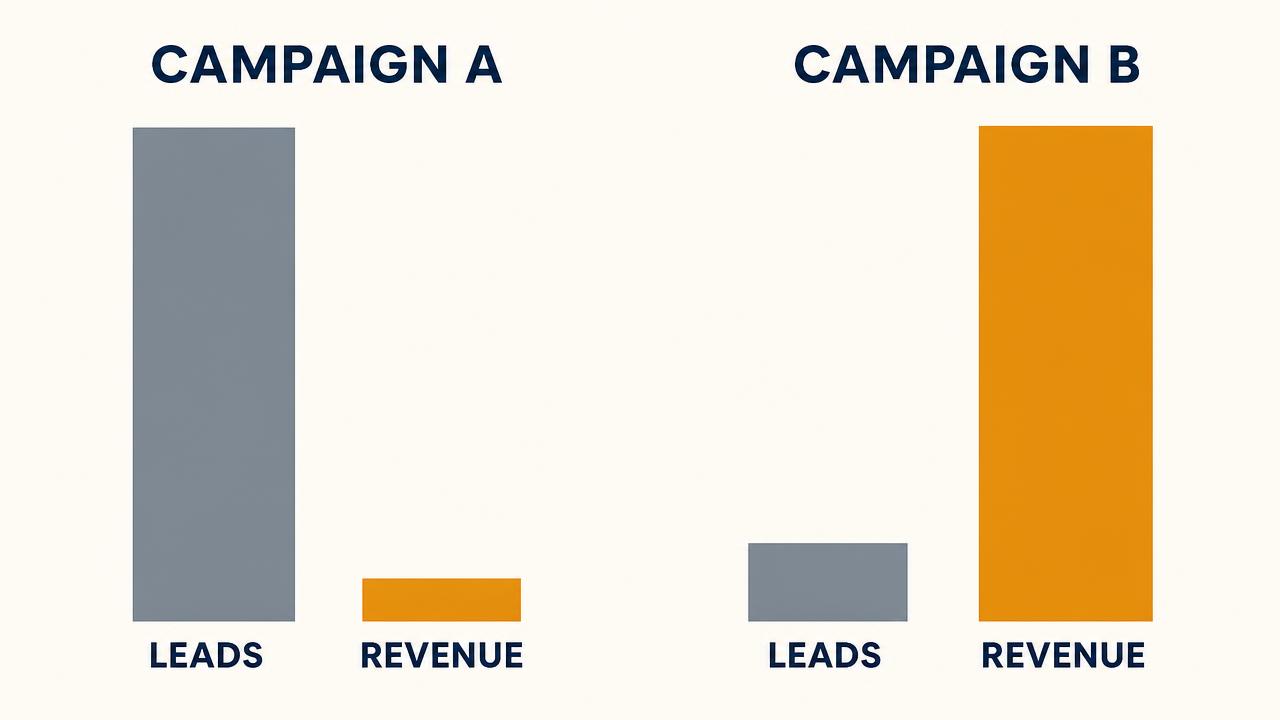
Two campaigns, the same ₹10,000 budget. One looks five times more efficient. The other is the one you should scale.
| Metric | Cheap lead campaign | Expensive lead campaign |
|---|---|---|
| Ad spend | ₹10,000 | ₹10,000 |
| Cost per lead | ₹100 | ₹500 |
| Total leads | 100 | 20 |
| Qualified leads | 12 | 14 |
| Sales conversations | 6 | 10 |
| Customers | 2 | 5 |
| Revenue (₹5,000 per customer) | ₹10,000 | ₹25,000 |
| Customer acquisition cost | ₹5,000 | ₹2,000 |
| Gross profit at 50% margin | ₹5,000 (break-even on ad spend) | ₹12,500 (₹2,500 above ad spend) |
Campaign A wins the only number most reports show, and loses everywhere it matters. It produced 100 leads and 2 customers, at a customer acquisition cost of ₹5,000 — exactly the revenue each customer brings, which means no profitable growth despite the cheap leads.
Campaign B produced a fifth of the leads and two and a half times the customers, at ₹2,000 per customer. It also saved the sales team eighty phone calls.
Illustrative example, not client data. The point is the relationship between the numbers, not the numbers themselves.
The metrics that matter more than cost per lead
Keep CPL on the report. Just stop making decisions with it alone. These six tell you what a campaign is actually worth.
Cost per qualified lead
Cost Per Qualified Lead = Ad Spend ÷ Qualified Leads
Not every lead deserves to be counted equally. A qualified lead matches your target customer, has a realistic need and can afford what you sell. Counting only those turns lead quality into a number your whole team can act on.
Lead-to-sale conversion rate
Lead-to-Sale Rate = Customers ÷ Total Leads × 100
This is the single metric that connects marketing to sales. If it falls while lead volume rises, you are buying worse leads. If it falls while lead quality holds, the problem is in follow-up or the sales process, not the ad account.
Customer acquisition cost
CAC = (Marketing Cost + Sales Cost) ÷ New Customers
CAC is the honest version of CPL. It includes the sales effort spent chasing leads that went nowhere, which is exactly the cost cheap leads hide. A campaign with a low CPL and a high CAC is an expensive campaign wearing a disguise.
Revenue per lead
Revenue Per Lead = Total Revenue ÷ Total Leads
Compare this against your cost per lead and you have the fastest sanity check available. If a lead costs ₹500 and produces ₹1,250 on average, volume is worth buying. If it costs ₹100 and produces ₹90, volume is what is hurting you.
Return on ad spend
ROAS = Revenue ÷ Ad Spend
ROAS is useful for comparing campaigns against each other, especially in e-commerce where revenue is immediate. It is less useful on its own, because it ignores margin. A 4x ROAS on a 20% margin product loses money; a 2x ROAS on a 70% margin service does not.
Customer lifetime value
LTV = Average Order Value × Purchase Frequency × Retention Period
Lifetime value is why a business with repeat custom can afford a much higher acquisition cost than a one-off seller. If a customer returns three times, the expensive lead that brought them in was never really expensive.
If you want the full measurement chain from impression to profit, including how to build the reporting behind it, that is covered in how Indian businesses should measure performance marketing.
Getting plenty of leads but struggling to turn them into customers?
I'll look at where your leads come from, how many are genuinely qualified, and what each customer actually costs you — no pitch, no obligation.
Audit My Lead QualityWhy cheap leads often have poor quality
Poor-quality leads are rarely bad luck. They are usually what the campaign was configured to buy. Five causes explain most of it.
Your targeting is too broad
Broad audiences and loose keyword matching give the platform the widest pool to find cheap conversions in. Volume rises, relevance falls, and your report looks better while your pipeline gets worse. Narrowing to the locations, age bands and search intent that match real customers usually raises CPL and raises revenue at the same time.
Your offer attracts freebie seekers
"Free", "cheapest" and "limited-time lowest price" all convert brilliantly, because they appeal to everyone including people who will never pay. If the reward for submitting a form is valuable on its own and requires no commitment, expect low intent. Move the offer closer to the purchase: a quote for their specific requirement, a site visit, a paid trial, a demo with a stated agenda.
Your lead form makes it too easy
Pre-filled instant forms can be submitted in two taps while scrolling, sometimes without the person registering what they applied for. That is not a fault in the platform — it is a choice about how much intent you want to filter for. Two or three qualification questions cost you volume and buy you contactability.
Your ads promise the wrong thing
If the ad implies one thing and the landing page or the sales call delivers another, the lead was genuine and the disappointment is yours to own. Message match — the same headline, the same offer, the same price framing from ad to page to call — is one of the cheapest quality fixes available.
Your campaign is optimising for the wrong event
Ad platforms optimise for exactly the signal you send them. Tell Google or Meta to find people likely to submit a form, and that is precisely who they will find — the system is working, it is just pointed at the wrong outcome. Where it is technically and operationally realistic, send a down-funnel event back: a qualified lead, an opportunity, or a closed sale.
The platform-specific version of this argument is worked through in detail for Meta Ads lead quality and for search campaigns in optimising Google Ads for revenue.
The hidden cost of a bad lead
A ₹100 lead almost never costs ₹100. Follow one through the business.
It arrives at ₹100. A salesperson spends fifteen minutes calling and messaging. They follow up three more times across the week. The lead occupies a CRM seat and dialler minutes. Marketing reviews it in the monthly report. It never converts.
The media cost was ₹100. The business cost was several times that — and the real damage is the eleventh lead of the day that nobody called because the team was still working through the first ten.
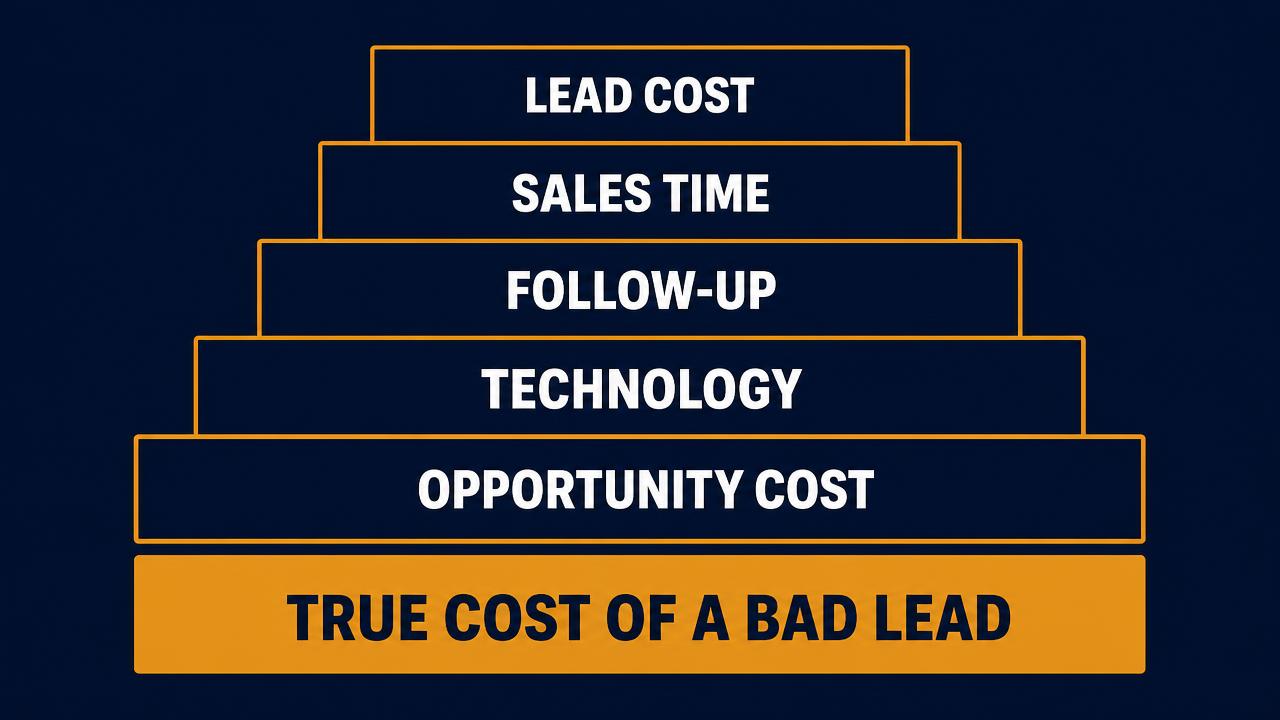
This is why lead volume without qualification is not a neutral outcome. It is an active tax on your sales capacity.
When expensive leads are actually better
A higher cost per lead is justified when the economics behind the lead absorb it. That is common in these situations:
- High-ticket services where one customer covers many wasted leads
- B2B, where the decision is slow and the contract is large
- Real estate, where a single closing outweighs months of ad spend
- Professional services with high margins and long client relationships
- SaaS, where subscription revenue compounds over the customer's lifetime
- Education businesses with high course fees and referral effects
- Premium products where brand fit matters more than reach
But an expensive lead is not automatically a good one. A high CPL with a poor conversion rate is simply an expensive failure. Before accepting a higher lead cost, check it against conversion rate, revenue per customer, profit margin and lifetime value. If those four support it, the cost is an investment. If they do not, it is just a more expensive version of the same problem.
How to know if your leads are actually good
Run your last month of leads through these ten questions before changing any budget.
- Does the lead match your target customer profile?
- Does the lead show genuine buying intent, not just curiosity?
- Does the lead have the budget your offer requires?
- Is the lead answering calls and messages?
- Can your sales team qualify the lead in one conversation?
- How many leads become real sales opportunities?
- How many opportunities become customers?
- What revenue came from this month's leads?
- What is your actual customer acquisition cost?
- Are those customers profitable after delivery costs?
If you cannot answer the last four, the problem is not lead quality yet — it is measurement. Start with conversion tracking and CRM connection before optimising anything else.
The Lead-to-Revenue Framework
Most businesses measure the top of the funnel and guess at the bottom. The Lead-to-Revenue Framework is the sequence I use to work out where a campaign is really losing money: lead cost, lead quality, qualification, sales conversion, customer acquisition, revenue, profit.
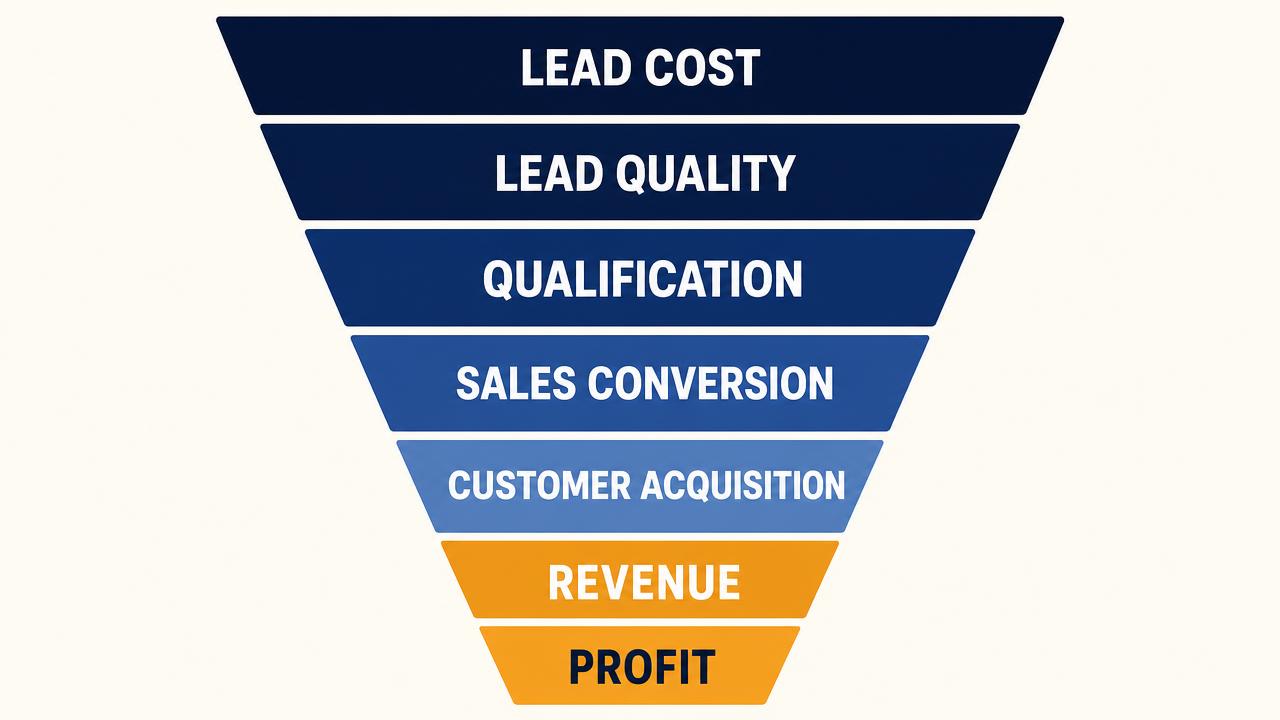
In campaign terms, the full journey looks like this:
Ad
The impression that starts everything. Cheap reach is easy; relevant reach is not.
Click
Interest, not intent. A click only means the message was worth a tap.
Landing page
Where intent is either built or lost. Most campaigns leak more here than anywhere else.
Lead
A contact detail. On its own it is a cost, not an outcome.
Qualified lead
A lead that matches your customer, has a need and can pay. The first stage worth celebrating.
Sales conversation
The real test of lead quality. Contact rate and conversation rate tell you far more than CPL.
Customer
Where marketing spend becomes a business result.
Revenue
The number your ad account almost never sees unless you connect it.
Profit
What is left after delivery, sales and overheads. The only number that funds growth.
Most marketers optimise stages one to four, because that is what the ad platform shows them. The difference between a good campaign and a profitable one is made in stages five to nine. The step-by-step build for this is in building a profitable performance marketing funnel from scratch, and the symptoms of a funnel breaking at stage six are covered in why Meta Ads generate leads but no sales.
Stop asking “how can we get cheaper leads?”
It is the wrong question, and it reliably produces the wrong answer. Replace it with these:
How can we generate more qualified leads at the same spend?
Which campaign produces the most customers, not the most leads?
Which campaign produces the most revenue?
Which audience or keyword theme converts best after the form?
What is our actual customer acquisition cost?
Are the customers we acquire profitable after delivery?
Where exactly is the funnel leaking — before the lead, or after?
How to improve lead quality without simply increasing ad spend
None of these require a bigger budget. Most of them will reduce your lead count and increase your customer count.
Improve your offer
Replace generic freebies with something only a real prospect would want: a quotation for their exact requirement, a paid diagnostic, a site visit, a sample tailored to their use case. The offer decides the motivation behind every submission.
Add qualification questions
Two or three, no more. Budget as a range, timeline as a choice, and location or requirement size. Open text fields get skipped; multiple choice gets answered honestly.
Improve audience targeting
On Meta, build lookalikes from your paying customer list rather than your lead list, and tighten geography to what you can serve. On Google, review match types, add negative keywords weekly, and separate high-intent search terms into their own campaign so budget follows intent.
Align ads with landing pages
The ad headline, the page headline and the offer should read as one continuous promise. Send campaign traffic to a dedicated page, never the homepage — and state price context on the page so unsuitable visitors self-select out.
Track qualified leads, not just leads
Write down what qualified means, apply it to every lead within a day, and record the outcome. Without this, lead quality stays an argument between sales and marketing and never becomes a metric anyone can improve.
Connect marketing data with sales data
Capture campaign, ad set and creative against every lead in your CRM, then report revenue back against those fields. This is where most businesses stop, and it is exactly where the useful answers start.
Optimise for better conversion signals
In Google Ads, import offline conversions so bidding learns from closed deals rather than form fills. In Meta, send qualified-lead or purchase events through the Conversions API. Even a weekly manual upload beats optimising against the Lead event forever.
Review search terms and audience quality
Read your Google Ads search terms report every week and exclude the informational and job-seeking queries. On Meta, check placement and demographic breakdowns for the segments producing volume without conversations, and exclude them.
For local service businesses running search campaigns, the budget-control side of this is covered in Google Ads for local businesses in India.
A better way to measure campaign performance
Marketing performance is measured at four levels. Most reporting stops at level two, which is exactly why cheap leads look like success.
LEVEL 1
Traffic metrics
Impressions · Clicks · CTR
Tells you the ad is being seen and is interesting. Says nothing about business outcome.
LEVEL 2
Lead metrics
Leads · CPL · Conversion rate
Tells you the funnel produces contacts efficiently. Still no evidence of quality.
LEVEL 3
Quality metrics
Qualified leads · Cost per qualified lead · Sales opportunities
The first level where marketing performance and sales reality meet.
LEVEL 4
Business metrics
Customers · Revenue · CAC · ROAS · Profit
The level that decides whether the campaign should be scaled, fixed or stopped.
The further down this list you can measure, the closer you get to knowing what your marketing is genuinely worth. A business reporting at level four rarely argues about cost per lead, because it already knows the answer that matters.
Final takeaway
Do not choose campaigns on cost per lead. A ₹100 lead that never becomes a customer is not cheaper than a ₹500 lead that reliably produces profitable revenue — it is simply cheaper to buy and more expensive to own.
The goal of performance marketing is not more leads. It is better business results: qualified leads, customers, revenue, profit, in that order.
Don’t optimise your ads for the cheapest lead. Optimise your marketing system for the most profitable customer.
Stop optimising for the cheapest lead
Start understanding which campaigns actually generate revenue. I'll review your targeting, offers, tracking and lead quality and tell you where the money is going.
Get a Paid Ads AuditLead quality is one of ten places growth breaks. If the wider picture is the issue, read why your ads can be working while your business is not growing.
Frequently asked questions
No. A cheap lead is only a problem when it does not convert. If a ₹100 lead consistently becomes a paying customer at an acceptable rate, that is an excellent campaign. The mistake is assuming a low cost per lead proves quality without checking how many of those leads reach a sales conversation and buy.
Related articles
How to Get Recommended by AI Search
A practical, no-guarantees guide to building the clarity, expertise, content, authority and technical access that support discovery across search and AI answers.
Google Ads and AI Search in 2026
AI Search is changing how people express intent and how Google Ads interprets it. A practical guide to campaigns, landing pages, conversion data and qualified growth.
Conversion Tracking for Google Ads & Meta Ads
Most accounts can report lead volume. Very few can say which campaigns produced customers. Here is how to connect ad clicks, leads, qualified leads and revenue.
Want this done for your account?
I run these campaigns for startups, e-commerce brands and local businesses from Pune — across India and the GCC.
Google Ads consultant in Pune
Search, Shopping and PMax managed for qualified leads.
Meta Ads consultant in Pune
Facebook and Instagram campaigns built around offer and creative.
Performance marketing consultant in Pune
Strategy, execution and measurement under one owner.
Google Ads lead generation
Lower cost per qualified lead, not just cheaper clicks.
Conversion tracking consultant in Pune
GA4, GTM, Meta CAPI and offline conversion imports.