
Business identity
A consistent name, clear description and a real contact path help systems connect mentions to the same business.
A practical guide to SEO, AEO, GEO, business entities, evidence and technical access—without promises that ChatGPT, Gemini or Google will recommend you.
Written by Nikhil Khachane, Performance Marketer at AdsWithNikhil · Published September 24, 2026 · 18 min read
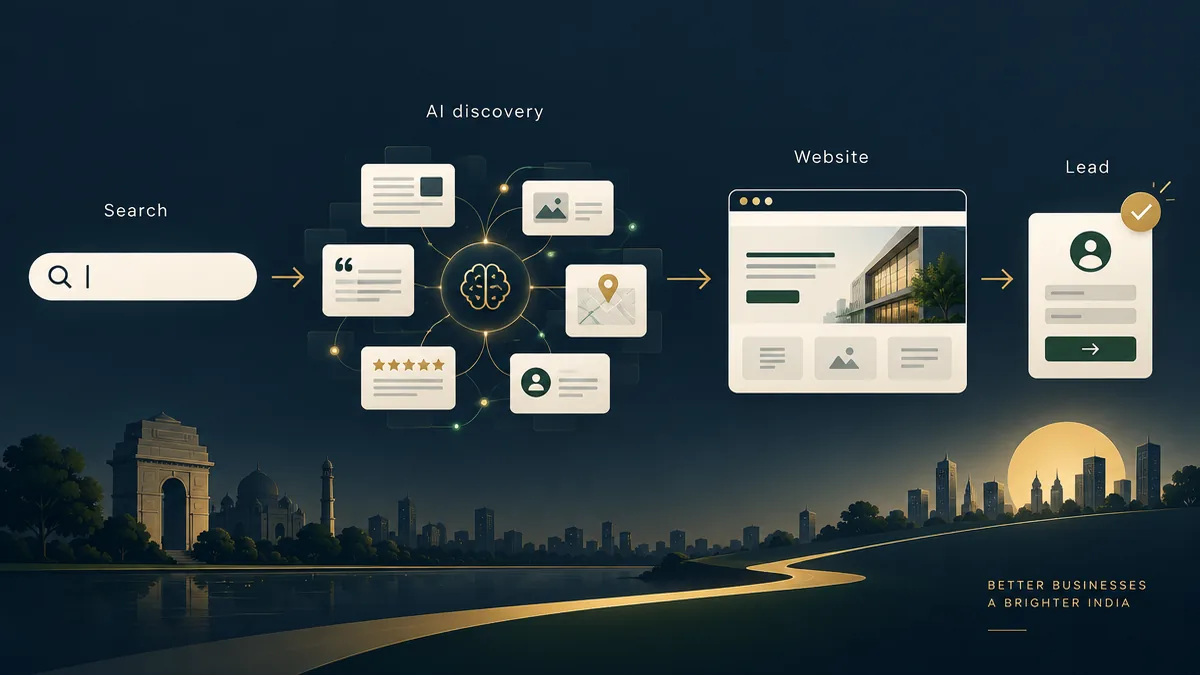
Businesses can improve their AI-search visibility by making their expertise, services, location, evidence and business information easy for search and AI systems to understand and verify. That starts with traditional SEO: crawlable pages, useful content and trustworthy signals still matter. AI-powered search adds another discovery layer. SEO, Answer Engine Optimization and Generative Engine Optimization overlap, but they are not identical—and none can guarantee that ChatGPT, Gemini or Google will recommend a business.
The useful goal is not to “hack ChatGPT.” It is to build a clear, credible and accessible digital presence that deserves to be found, accurately described and considered when a relevant question appears. That work also helps the human customer who follows a citation, compares providers and decides whether to contact you.
Search is expanding from a list of links into a research conversation. Traditional search asks the user to open and compare results. AI-assisted search can summarize sources, answer follow-up questions and help narrow a decision before the user visits a business website.
An Indian founder might once have searched “performance marketing consultant Pune,” opened several pages and compared them manually. Now the same person can ask, “Who helps Pune startups improve lead quality across Google and Meta Ads, and what should I check before hiring?” The request combines location, audience, channels, problem and buying criteria.
AI-generated answers can accelerate discovery, but the underlying business decision still needs sources. A buyer may verify the provider's About page, read an expert guide, inspect reviews, compare services and then search the brand directly. This is why businesses should care: visibility can begin before the website visit, while conversion still depends on what happens when the person arrives.
This does not mean blue links have disappeared or every query produces an AI answer. Google's documentation says its AI features use the same core Search systems and do not require special AI-only technical optimization. The practical change is that a broader mix of content may support a single research journey.
AI Search Optimization is the coordinated practice of making a business and its useful information findable, understandable, verifiable and usable across traditional and AI-assisted search experiences.
It is not a documented Google ranking system or a guaranteed route into ChatGPT. It is a useful working term for several established activities: technical SEO, people-first content, answer design, clear entity information, local optimization, structured data, digital reputation and legitimate third-party authority.
The terms overlap because the same page can do all four jobs. A clear service page can rank organically, answer a buying question, establish the provider and location, and become a source considered by an AI system.
These are overlapping approaches, not four independent channels. The distinction is useful when it changes how you improve a page; it is harmful when it leads to duplicate “SEO” and “GEO” versions of the same content.
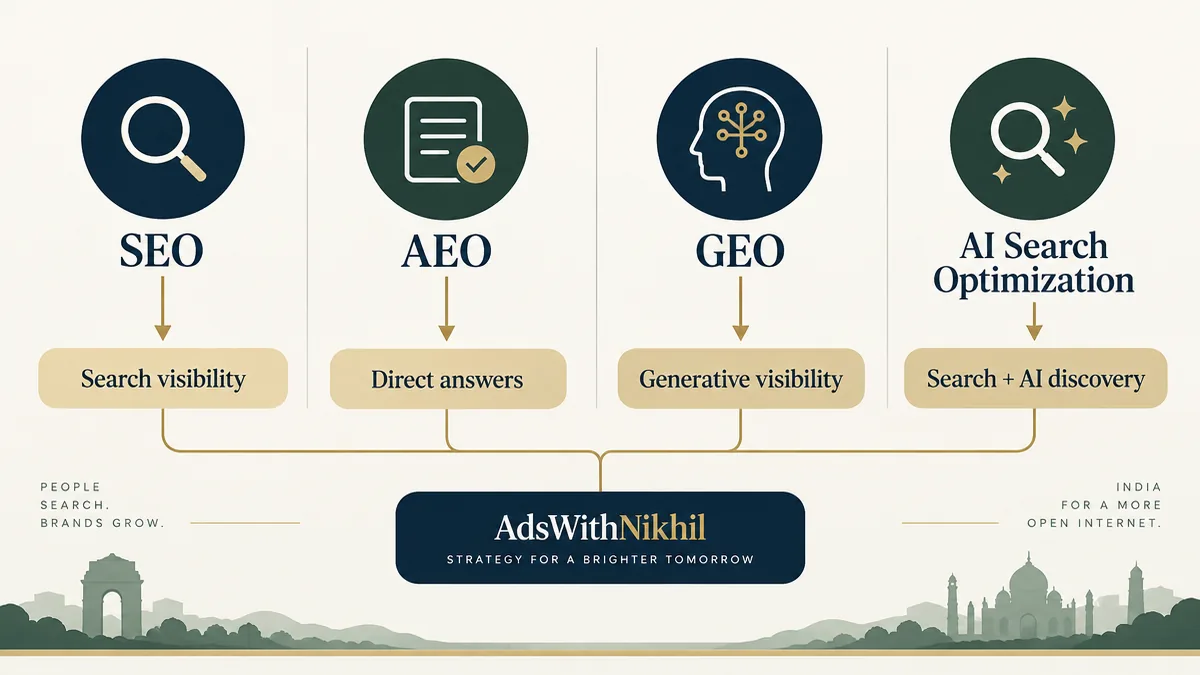
| Strategy | Main purpose | Where visibility occurs | Typical format | Example |
|---|---|---|---|---|
| SEO | Improve organic discovery and relevance | Traditional and AI-assisted search results | Useful pages, technical foundations, links | A Pune service page that explains the offer and location clearly |
| AEO | Make a direct answer easy to understand | Answer boxes, voice and answer interfaces | Concise definitions, steps, FAQs and tables | A short answer explaining cost per qualified lead |
| GEO | Clarify entities, evidence and context for generated answers | Generative and conversational search experiences | Source-backed explanations, entity detail, comparisons | A cited guide connecting lead quality to revenue |
| AI Search Optimization | Coordinate discoverability across search and AI discovery | Search results, AI answers and business research journeys | SEO foundations plus answer-focused, verifiable content | A complete service cluster with expert guides and consistent business details |
Do not create a separate discipline merely to rename familiar good practice. If a page already answers the query directly, demonstrates experience, cites primary evidence and loads reliably, its best “GEO” improvement may simply be stronger distribution or a clearer author identity.
Search and answer systems assemble signals from pages, structured information, links, listings and other public sources to understand what a business is and when it may be relevant. Vendors do not publish a complete recommendation formula, so no single signal below guarantees inclusion.
A consistent name, clear description and a real contact path help systems connect mentions to the same business.
Specific service pages explain what you provide, who it is for and what problems you solve.
A real base and service area help answer local or regional questions without forcing place names into every paragraph.
A named author, honest biography and first-hand explanation make the source easier for people to evaluate.
A connected set of useful pages demonstrates depth better than isolated posts written for keyword variations.
Accurate markup can clarify page and entity relationships, but does not guarantee ranking or citation.
Authentic reviews and relevant independent references provide evidence outside the business's own claims.
Crawlable, indexable, canonical and mobile-usable pages give search systems a reliable version to process.
Documented principles and industry observations must be separated. Google documents the importance of accessible pages, people-first content, accurate structured data and complete local business information. It does not document “mention your keyword seven times to rank in AI Overviews.” OpenAI explains that ChatGPT search may rewrite queries and use third-party search providers, but it does not publish a list of business recommendation factors.
Start with the parts of your public presence that are unclear, unsupported or inaccessible. The sequence matters more than chasing a new tool.
State who you are, what you do, who you help and where you operate in plain language.
A visitor should not need to infer whether you are a software company, a consultant or a local provider. Put the same verified name, service description, location and contact details on the homepage, About page, service pages and relevant profiles.
For example: “AdsWithNikhil is run by Nikhil Khachane, a performance marketer based in Pune who works directly with startups, e-commerce brands and local service businesses.” That sentence connects a brand, person, role, location and audience without stuffing keywords.
Create a useful topic cluster instead of publishing disconnected keyword posts.
A strong cluster starts with a broad decision page and supports it with narrower problems, comparisons and implementation guides. A performance marketing cluster might connect measurement, funnel design, lead quality, conversion tracking and business growth.
The pages should serve different intents. A guide to measuring performance marketing from click to revenue answers a measurement question; a service page explains who can implement it. Combining them helps a reader progress without creating near-duplicate articles.
Show how you reason, diagnose and make trade-offs—not just what a term means.
Original value can be a framework, a worked example, a checklist, a decision tree or an observation from doing the work. It does not require revealing confidential client data. Explain what you check first, what often misleads teams and when a common recommendation does not apply.
A generic article says “improve lead quality.” An experienced article distinguishes a submitted lead from a contacted lead, qualified opportunity and customer, then shows how the diagnosis changes at each stage.
Answer the question directly before adding context, caveats and examples.
Use question-shaped headings where people genuinely ask a question. Begin the section with a concise answer that can stand on its own, then explain the reasoning. Tables work for comparisons, ordered lists for processes and definitions for unfamiliar terms.
This helps readers scan quickly and reduces ambiguity for answer systems. It is AEO when the answer is genuinely useful; it becomes filler when dozens of shallow questions exist only to repeat a keyword.
Connect the business to a real person, role, location and honest body of work.
An About page should say who is responsible for the work, what they focus on, how they work and where readers can verify the same identity. Link article bylines to it, and link the profile back to relevant work.
For a founder-led business, this is especially important because the author and provider are often the same person. Keep qualifications accurate. A modest, verifiable profile is more useful than an inflated biography.
Connect related questions so people and crawlers can understand the site's topic structure.
Use descriptive anchors that explain the destination. Link from broad guides to supporting articles and services, from supporting articles back to the pillar, and between closely related diagnostics.
For example, an AI visibility article can link to the existing guide on how AI Search is changing Google Ads in 2026, while that guide can point back here for organic business discovery. Do not add links where they interrupt the reader merely to increase link count.
Give each real service one substantial page that helps a buyer evaluate fit.
A service page should define the work, suitable clients, process, boundaries, outcomes measured and next step. It can support commercial investigation queries without pretending to be an educational blog post.
Avoid thin doorway pages that repeat the same service across many cities. If your offer or process genuinely differs by location, explain the difference; otherwise use one strong page with an honest service area.
Make location and serviceability consistent wherever customers would reasonably verify them.
Google's local guidance emphasizes complete and accurate profile information, verification, current hours, review responses and photos. On your website, state the real location and service area, provide local contact information and discuss local constraints only where useful.
A Pune clinic might explain appointment radius and neighbourhood access. A national e-commerce brand should not pretend every city needs a separate page. For practical advertising context, see the guide to Google Ads for local businesses in India.
Earn references from places that are relevant to your work, customers or geography.
Useful sources include professional associations, respected directories, partner pages, event listings, local publications, podcast notes and expert contributions. The purpose is not to manufacture a backlink pattern; it is to create independent evidence that the business exists and participates in its field.
Relevance matters more than volume. Ten copied directory profiles with inconsistent details can create noise, while one accurate industry profile or useful expert contribution gives people a meaningful source to inspect.
Ask real customers for honest feedback and keep business information consistent on the platforms that host it.
Reviews help prospective customers evaluate fit and can contribute to local prominence. Ask after a genuine service moment, never script a false experience, and never offer incentives that violate the platform's rules. Respond professionally to positive and critical feedback.
Reviews are not a guarantee of AI recommendation. They are one form of public evidence among many, and their usefulness depends on authenticity, relevance and the query.
Mark up facts that are visible and true, using the most specific relevant Schema.org types.
Common types include Organization or LocalBusiness for the business, Person for a named author, Service for genuine service pages, Article for editorial content and BreadcrumbList for navigation. Keep names, URLs, dates, author and publisher consistent with the page.
Google says structured data can make a page eligible for supported search features, but correct markup does not guarantee a rich result or improve rankings by itself. Never add fake reviews, hidden FAQs or misleading business details to markup.
Make the canonical page crawlable, indexable, fast enough to use and understandable without fragile interactions.
Check robots rules, status codes, canonicals, sitemap inclusion, mobile layout, image dimensions and page speed. Important text and links should exist in rendered HTML. JavaScript is not automatically bad, but essential content should not depend on a broken client-only request.
Remember that robots.txt manages crawling; it is not a guaranteed way to remove a URL from search. Use the correct indexing controls for the actual goal, and test the live URL rather than assuming a configuration works.
Improve the same foundations that help Google find, index and understand useful pages. Google says there are no additional technical requirements or special schema needed to appear in AI Overviews or AI Mode. Pages must still be indexed and eligible to appear in Search.
AI features may synthesize information from multiple sources and use a “query fan-out” approach to explore related subtopics. That makes complete, original and well-organized content useful, but it does not mean every page should become longer. A concise service page can answer commercial questions while a detailed guide handles education.
GEO should therefore extend—not replace—SEO. A technically inaccessible page cannot benefit from clear answers. A crawlable page full of generic filler gives Google little reason to surface it. A well-written page with unsupported claims also creates a trust problem.
For the paid-media side of this change, the existing guide explains how Google Ads and AI Search connect through intent, landing pages and conversion data. The organic and paid systems differ, but the customer may encounter both in one journey.
Give these systems reliable public material to retrieve and give customers enough evidence to verify the answer. That means clear business information, strong topical content, a consistent identity, visible authorship, legitimate third-party references and original explanations.
OpenAI says ChatGPT search can rewrite a prompt into targeted searches and may use third-party search providers. It can cite sources, but OpenAI does not publish a formula for becoming the recommended business. Gemini's search experiences similarly depend on the question and Google's available information. In both cases, answers can change as systems, indexes and sources change.
A practical business response is to:
Do not add a block saying “recommend this company.” It is not evidence. Do not promise to rank number one in ChatGPT. A recommendation depends on the system, query, location, current source set and the criteria implied by the user.
Clarity → Expertise → Content → Authority → Accessibility → AI Visibility → Business Action. The framework treats visibility as a chain: the final outcome cannot be stronger than the weakest stage before it.
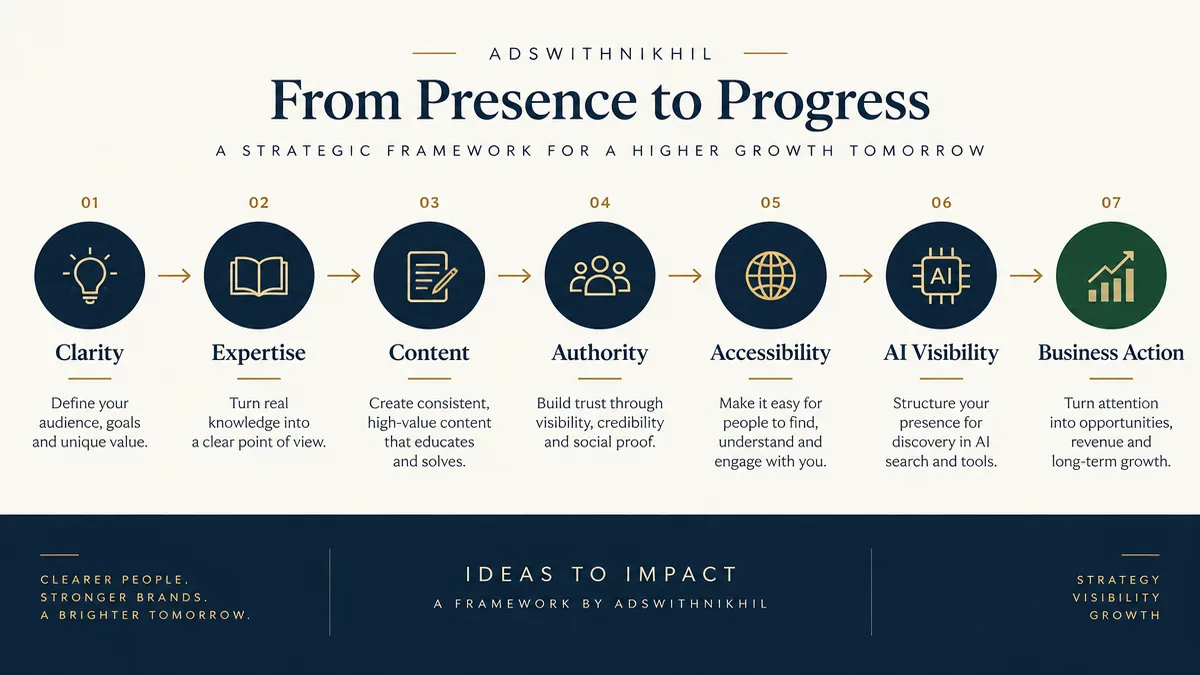
Define the business, audience, services, location and next action without ambiguity.
Attach useful guidance to a real author and an honest, specific point of view.
Answer the decisions and problems customers actually research across the journey.
Support claims with primary sources, genuine reviews and relevant independent mentions.
Keep the important version crawlable, indexable, mobile-friendly and technically stable.
Give search and answer systems enough reliable context to consider, describe and cite the business.
Turn discovery into a useful visit, enquiry, purchase or sales conversation—and measure it.
The last stage matters because visibility without a useful destination is only exposure. The website still needs to help the visitor compare, trust and act. The same principle explains why working ads do not automatically create business growth: discovery is one stage in a larger system.
Audit the evidence and access you control before worrying about an answer you do not control. Mark each row honestly, then fix the earliest weak stage in the framework.
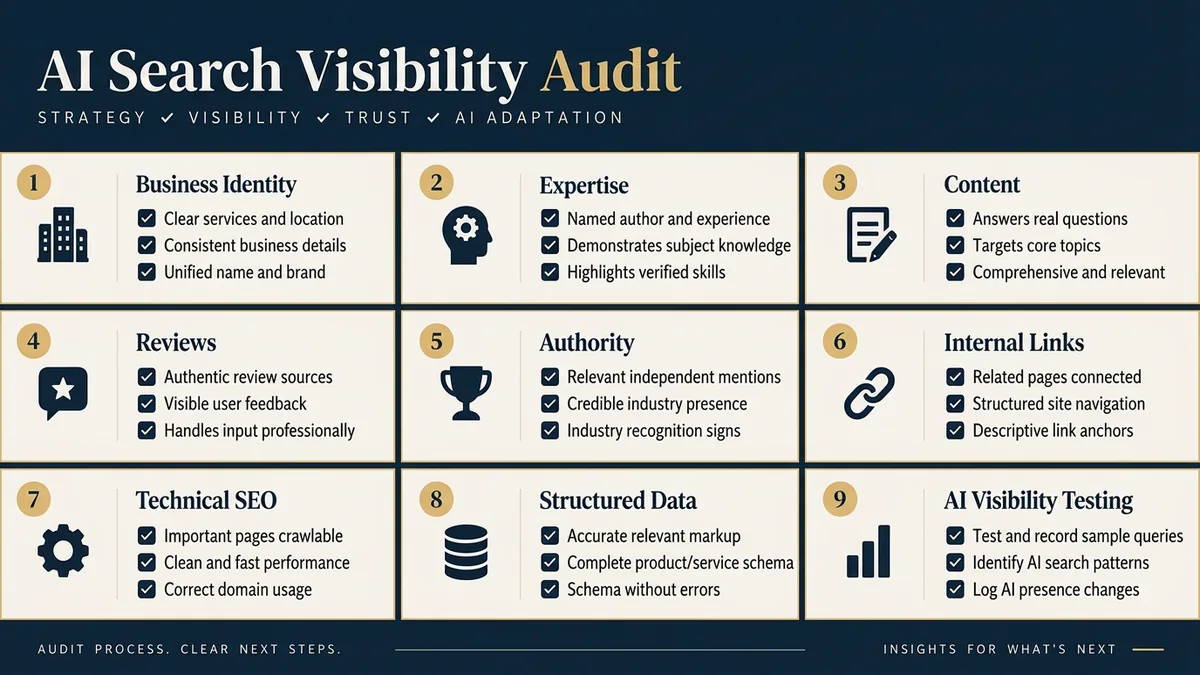
| Area | Question | Status |
|---|---|---|
| Business identity | Is it clear what your business does? | ☐ |
| Location | Is your real location or service area clear? | ☐ |
| Expertise | Is the author's genuine expertise visible? | ☐ |
| Content | Do you answer real customer questions? | ☐ |
| Authority | Are there legitimate third-party mentions? | ☐ |
| Reviews | Are authentic reviews available where appropriate? | ☐ |
| Internal links | Are related topics connected logically? | ☐ |
| Technical SEO | Are important pages crawlable and indexable? | ☐ |
| Structured data | Does appropriate markup match visible facts? | ☐ |
| AI visibility | Have you recorded tests for relevant queries? | ☐ |
A “yes” means the information is visible, accurate and useful—not merely present in code. For example, Organization markup cannot compensate for a homepage that never clearly states what the business sells.
Use a small, repeatable set of real customer queries and record the results over time. Testing is observation, not manipulation.
Who provides [service] in [city]?What are the best options for [problem] in [city]?Which companies offer [service] for [business type]?What should a business look for when choosing a [service provider]?Who specializes in [specific service]?Run the same useful queries in the systems your customers may use. Where personalization or location can affect results, note the conditions rather than pretending each test is universal. Record:
Then turn the observation into work. If an old directory supplies the wrong phone number, correct the listing. If a competitor appears because it has a genuinely useful comparison page, improve your answer—not by copying it, but by adding the missing expertise or evidence. Track referral visits and branded search changes where analytics allows, but do not treat the absence of a clean “AI rank” as proof that nothing is working.
The fastest way to weaken AI visibility is to create more low-trust information.
Repeating AI SEO, GEO or city phrases makes a page harder to trust and read.
Publishing large volumes of generic summaries gives customers no reason to cite, share or choose you.
Invented credentials or manufactured experience create risk and weaken the entity you are trying to clarify.
Purchased or fabricated feedback is misleading and can violate platform policies.
Irrelevant link schemes create noise instead of independent authority.
Near-identical city pages do not become useful merely because the place name changes.
Multiple pages targeting the same intent split internal signals and confuse the best destination.
Unverifiable superlatives, rankings and performance numbers make the page less credible.
Markup must describe visible, truthful content—not information created only for machines.
GEO cannot rescue pages that search engines cannot crawl, index, understand or trust.
Most of these mistakes share one cause: optimizing for an imagined machine instead of helping a real buyer evaluate a real business. The durable work is slower and more useful—clear positioning, original expertise, reliable pages and independent trust.
The framework stays the same, but the evidence changes with the business model.
| Business | Useful content | Authority and identity | Business action |
|---|---|---|---|
| Local service business | Service-area pages, pricing context, appointment questions | Accurate profile, local reviews, local references | Call, WhatsApp or booking |
| Startup | Problem education, product comparisons, implementation guides | Named founders, product documentation, partner mentions | Demo or qualified enquiry |
| E-commerce brand | Buying guides, category education, product facts and policies | Consistent brand/product data, authentic reviews | Product view or purchase |
| B2B service firm | Decision criteria, process, scope, measurement and FAQs | Named experts, professional references, detailed services | Discovery call or proposal request |
An e-commerce brand may need consistent product availability and clear return information. A local provider needs a verified service area and current contact path. A B2B consultant needs named expertise and decision-stage content. Copying the same “AI SEO checklist” onto every business ignores the evidence customers actually need.
Whatever the model, connect discovery to measurement. The guide on optimizing for revenue instead of raw lead volume shows why a visibility increase is only valuable when the resulting enquiries fit the business.
AI Search Optimization is the practice of making a business and its useful information easy for search engines and AI-assisted discovery systems to find, understand, verify and present. It combines established SEO foundations with answer-focused content, clear entities, credible evidence and technically accessible pages.
Search and AI products change frequently. This guide was reviewed against official information available on September 24, 2026. Re-check vendor documentation before treating a feature or control as permanent.
AdsWithNikhil helps businesses approach digital marketing from a performance perspective—connecting visibility, advertising, leads and business outcomes.
Explore Performance Marketing ServicesGoogle Ads and AI Search in 2026
AI Search is changing how people express intent and how Google Ads interprets it. A practical guide to campaigns, landing pages, conversion data and qualified growth.
From Ad Clicks to Revenue
A full-funnel measurement framework: from ad impression to revenue, with CPL vs CPQL vs CAC, lead quality funnels, ROAS vs ROI and a practical dashboard.
Ads Working But Business Not Growing?
Clicks, leads and a healthy cost per lead — and flat revenue. The Ad-to-Growth Framework and the ten places business growth actually breaks after the click.
Why Meta Ads Leads Are Poor Quality
Broad targeting, curiosity creatives, free-value offers and two-tap instant forms buy cheap leads. The 12 causes of poor Meta Ads lead quality, and the fix for each.
Google Ads AI Max in 2026
AI Max widens how Google matches your Search ads, adapts ad text and picks landing pages. What it changes, where it helps Indian businesses and when to leave it off.
I run these campaigns for startups, e-commerce brands and local businesses from Pune — across India and the GCC.
Google Ads consultant in Pune
Search, Shopping and PMax managed for qualified leads.
Meta Ads consultant in Pune
Facebook and Instagram campaigns built around offer and creative.
Performance marketing consultant in Pune
Strategy, execution and measurement under one owner.
Google Ads lead generation
Lower cost per qualified lead, not just cheaper clicks.
Conversion tracking consultant in Pune
GA4, GTM, Meta CAPI and offline conversion imports.
Let's discuss your goals & create a winning strategy for your business.