
Your Ads Are Working, So Why Is Your Business Still Not Growing?
Clicks are up. Leads are coming in. Cost per lead looks healthy. And revenue has not moved. Here are the ten places growth actually breaks — most of them after the click.
By Nikhil Khachane · Performance marketer · 14 min read
Your Google Ads campaign is generating leads. Your Meta Ads are getting clicks at a reasonable price. Cost per lead has come down since last quarter. The reporting dashboard is green almost everywhere you look.
And the business feels exactly the same as it did six months ago.
This is one of the most common and most frustrating situations in performance marketing, and it is rarely solved by changing bids. A successful advertising campaign and a growing business are two different outcomes, produced by two overlapping but separate systems.
Quick answer: Ads can succeed at their own job — impressions, clicks, traffic and leads — while the stages after the click fail to convert that demand into customers, revenue and profit. Growth usually breaks in traffic quality, the landing page, lead qualification, follow-up speed, the offer, acquisition cost, retention or margin. Find the weakest stage before changing the budget.
Your ads can be working while your business is still not growing
An advertising platform is responsible for a narrow set of outcomes. It can put your message in front of people, earn a click, deliver a visitor and record a conversion event. Within that scope, a campaign can genuinely be performing well.
None of those outcomes are business growth. Growth appears further down the chain, after the landing page has done its job, after someone has qualified the enquiry, after a salesperson has called back quickly, after the offer has beaten whatever else the person was considering, and after the work has been delivered at a margin worth having.
Your ads are only one part of your growth system.
This is why “the ads are not working” is so often the wrong diagnosis. In most accounts I review, the advertising is somewhere between adequate and good. The growth problem is real, but it is sitting two or three stages downstream, where nobody is measuring.
The biggest problem: you are using the wrong definition of “working”
Ask four people in the same business whether the marketing is working:
- Marketing: “We generated 500 leads this quarter, up 40%.”
- Sales: “Only about 30 of them were worth calling twice.”
- Finance: “We spent more and profit did not move.”
- The owner: “Nothing has changed.”
Every one of them is telling the truth. They are simply measuring different stages of the same funnel, and no single one of those stages describes the business.
| Metric | What it measures | What it does not guarantee |
|---|---|---|
| CTR | How interesting your ad is | That the click has buying intent |
| CPC | How competitive the auction is | That the traffic is relevant |
| CPL | How cheaply you collect contacts | That the lead can or will buy |
| Conversions | That an action happened | That a customer was created |
| ROAS | Revenue against media spend | Profit after all other costs |
| Leads | Potential customers | Actual sales |
| Customers | Acquisition | Retention or lifetime value |
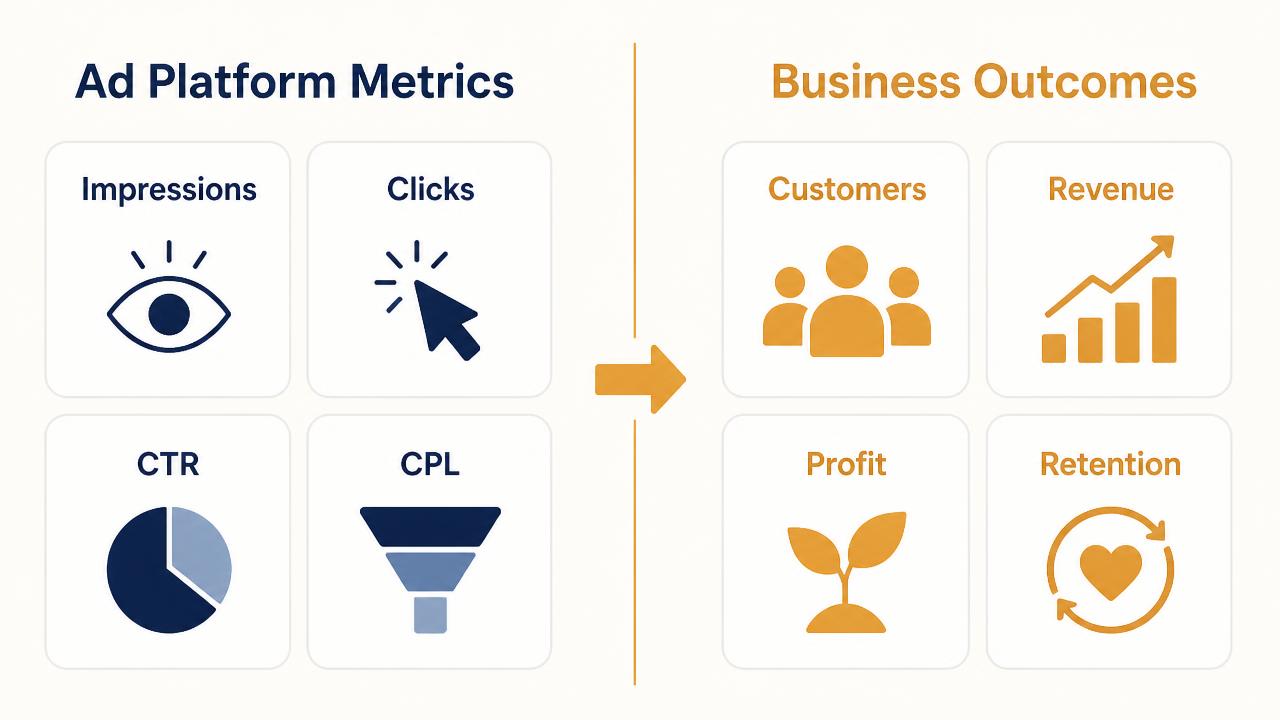
The practical fix is not to abandon the left-hand column. It is to stop making budget decisions with it. Once your reporting reaches the right-hand column, most internal arguments about whether the ads are working simply disappear.
The Ad-to-Growth Framework: where is your business actually breaking?
This is the framework I use to diagnose flat growth. It treats advertising as the first stage in a chain rather than the whole machine.
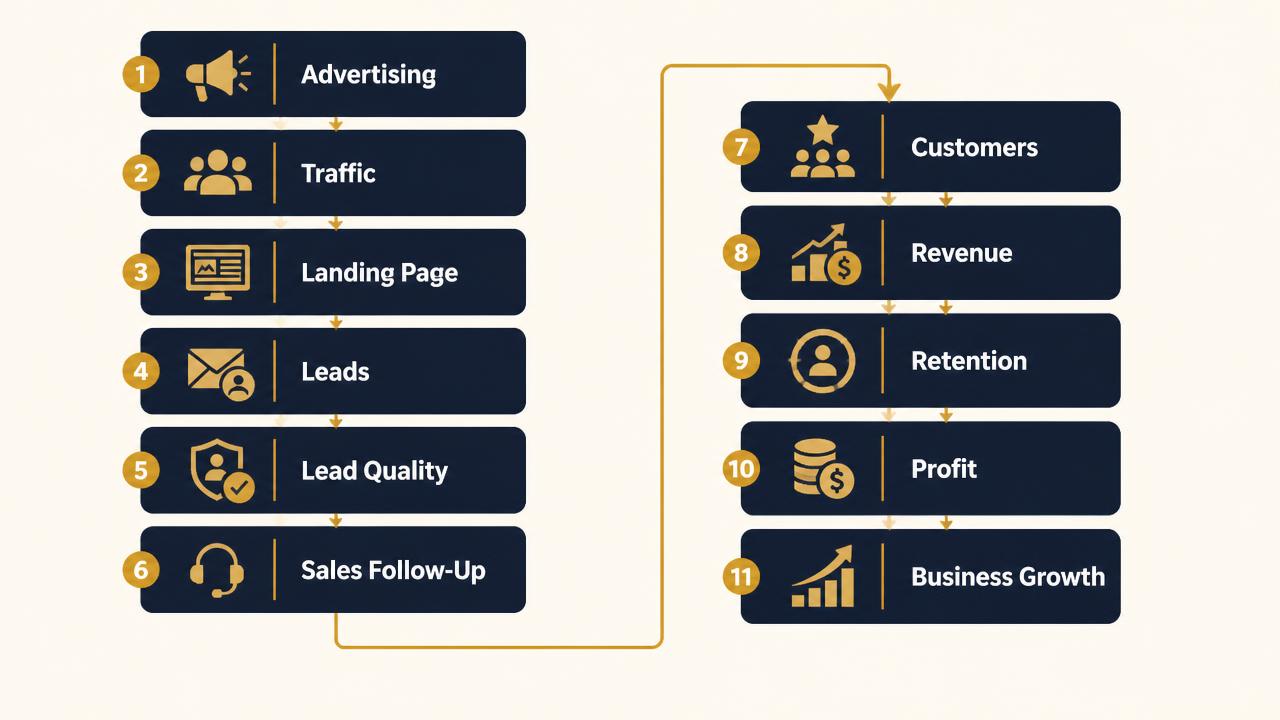
Advertising → Traffic → Landing Page → Leads → Lead Quality → Sales Follow-Up → Customers → Revenue → Retention → Profit → Business Growth.
Every stage limits the one after it, which is why isolated improvements so often fail to show up in the bank account:
- Great ads + a weak landing page = wasted traffic
- Great leads + slow follow-up = lost customers
- Great customers + poor retention = limited growth
- Great revenue + thin margins = no profit to reinvest
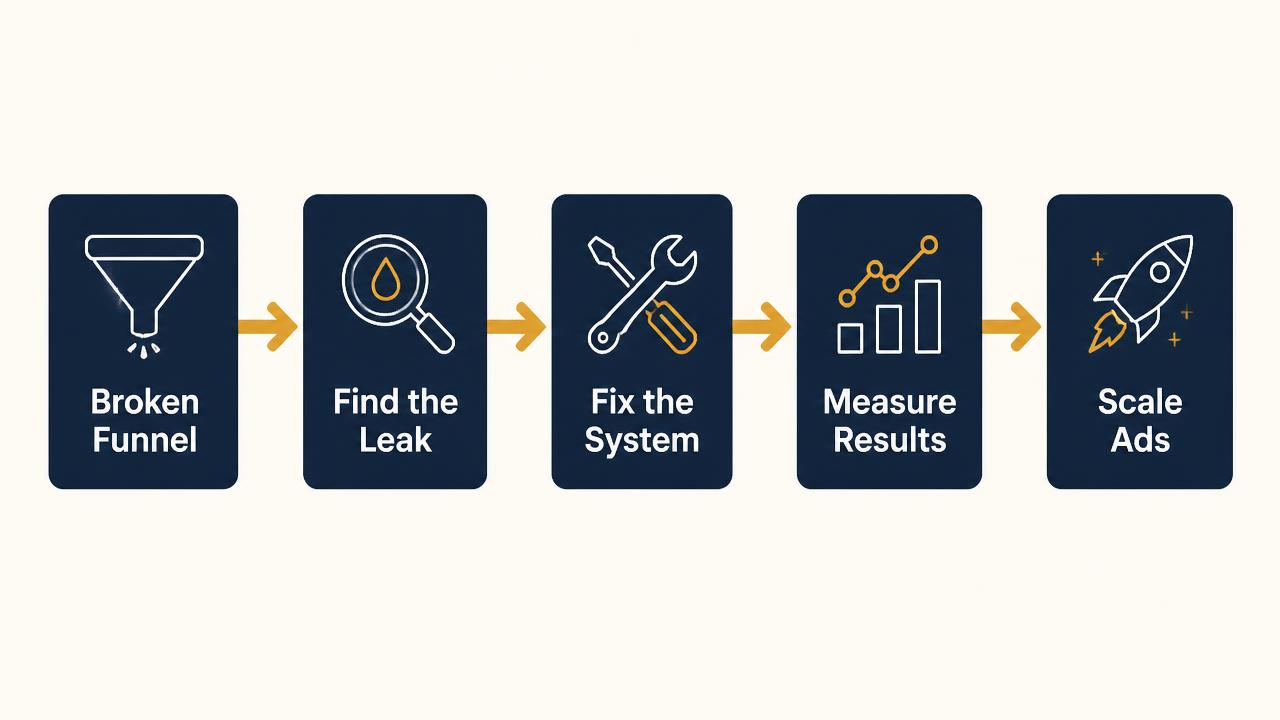
The job is not to improve every ad. It is to find the stage where the system is leaking hardest, fix that, and then move to the next weakest link. The ten problems below are the leaks I see most often, roughly in funnel order.
Not sure which stage is holding your growth back?
Ads, landing page, lead quality or sales follow-up — in ten minutes I'll tell you which one your numbers point at, and what I would fix first.
Audit My Growth FunnelProblem #1 — You are getting traffic, but it is the wrong traffic
More traffic is not better traffic. A campaign can double its clicks by widening its net, and every extra click can be worth less than the one before it.
On Google Ads, this is usually an intent problem. Broad match and loose keyword themes pull in research queries, job seekers, students, DIY searchers and people in cities you do not serve. The search terms report is where this shows up, and in most accounts it has not been read in months.
On Meta Ads, it is usually a message problem. A curiosity-led creative earns cheap clicks from people who were entertained rather than interested. If the ad does not say who the offer is for, the algorithm cannot know either.
Traffic quality checklist
- Search terms report reviewed in the last 30 days, with irrelevant terms added as negatives
- Location targeting set to presence in areas you actually serve, not interest
- Audiences built from customers, not just from anyone who filled a form
- Ad copy states what you sell, who it is for and roughly what it costs
- Creative promises the same thing the landing page delivers
- Placements and networks reviewed, with the weakest ones excluded
For local service businesses, the budget-control side of this is covered in detail in Google Ads for local businesses, which walks through how to generate leads without wasting budget on the wrong searches.
Problem #2 — Your landing page is losing people before they become leads
You pay for every visitor whether they convert or not. A landing page that converts at 2% instead of 6% makes your advertising three times more expensive without a single change in the ad account.
The usual causes are unglamorous and fixable:
- Slow loading on mobile data, especially with heavy hero images or sliders
- A headline that does not repeat the promise made in the ad
- Too many links, menus and distractions competing with the one action
- No clear call to action above the fold
- No trust signals: no real photos, no specifics, no reason to believe you
- A form that asks for more than the visitor is ready to give
Great ad + weak landing page = wasted ad spend. The page is where the money is either converted or lost.
Message match is the cheapest fix available. If the ad says “same-day AC repair in Pune”, the page headline should say the same thing, in the same words, before the visitor has to scroll or think.
Problem #3 — You are getting leads, but they are not qualified
This is the single most common reason a business gets leads and no growth, so it is worth being precise about the words.
A lead is someone who has shown interest by giving you their contact details. A qualified lead is someone who matches your target customer, has a genuine requirement, can afford what you sell and has a realistic chance of buying.
The gap between those two definitions is where marketing budgets disappear. The usual causes:
- Targeting far broader than the customers you can actually serve
- A free-value offer that appeals to everyone, including people who never buy
- Two-tap instant forms submitted without the person registering what they applied for
- Ads that hint at a price you do not actually offer
- No qualification questions anywhere in the process
- Platform bidding optimised toward the Lead event, which is exactly what it delivers
The economics of this are worth understanding properly: cheap leads are not always profitable, and lead quality matters far more than cost per lead. If most of your volume comes from Facebook and Instagram, the platform-specific causes are covered in why Meta Ads leads may be poor quality.
Problem #4 — Your sales follow-up is too slow
A lead is at its most interested at the moment it is submitted. Interest decays from there, and it decays fastest for the leads who contacted several businesses at once.
Here is the sequence that quietly kills good campaigns:
- The form is submitted in the evening
- Nobody sees it until the next working day
- One call is attempted; the phone is not answered
- No WhatsApp message follows
- No second attempt is made
- The lead is marked “not interested” and used as evidence the ads are poor
Advertising created that demand successfully. The business failed to capture it. Things worth putting a number against: time to first contact, number of attempts per lead, which channels are used, who owns the lead, and what happens when they are on leave.
If the pattern feels familiar, the full breakdown of why enquiries stall is in getting Meta Ads leads but no sales.
Problem #5 — Your sales team is not converting marketing leads
Marketing says the leads are fine. Sales says the leads are terrible. Both positions are usually held with total confidence and no shared data.
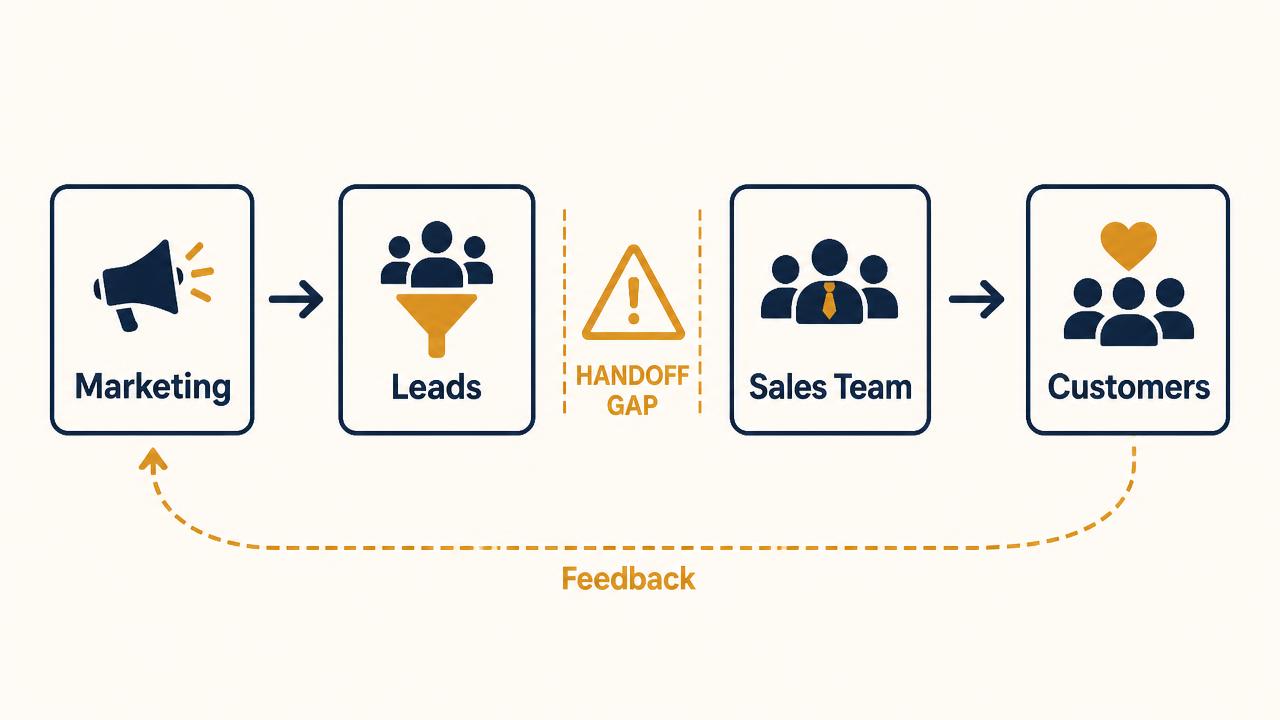
The disagreement is almost never about effort. It is about definition. Until both teams agree in writing what makes a lead qualified — location, budget band, requirement, timeline, decision authority — every conversation about quality is two people using one word to mean two things.
Once that definition exists, a feedback loop becomes possible:
Marketing metrics → Lead quality → Sales feedback → Customer data → Campaign optimisation
That loop is what turns a campaign from a lead generator into a customer generator, and it costs nothing but discipline.
Problem #6 — Your offer is not strong enough
Sometimes the targeting is right, the page is fine, the follow-up is quick, and people still do not buy. At that point the problem is not the campaign. It is the offer.
An offer is judged against alternatives, including the alternative of doing nothing:
- Price relative to the perceived value, not relative to your costs
- Differentiation — what a competitor genuinely cannot say
- Risk reduction: guarantees, trial periods, transparent scope
- A clear, low-commitment next step rather than “contact us”
- A real reason to act now instead of later
If your ideal customer sees your offer, why should they choose you rather than a competitor — or simply do nothing?
If the honest answer is thin, no amount of bid strategy will rescue it. Advertising amplifies an offer; it does not create one.
Problem #7 — You are measuring leads instead of revenue
Two campaigns, same month, same business. Which one is performing better?
| Metric | Campaign A | Campaign B |
|---|---|---|
| Leads | 100 | 40 |
| Cost per lead | ₹300 | ₹600 |
| Ad spend | ₹30,000 | ₹24,000 |
| Customers | 5 | 12 |
| Cost per customer | ₹6,000 | ₹2,000 |
Illustrative example, not client data. The relationship between the numbers is the point.
Campaign A wins every metric on a standard report and loses the only comparison that matters. If the business optimises toward the cheaper cost per lead, it will scale the worse campaign and pause the better one.
The fix is to measure further down: qualified leads, cost per qualified lead, opportunities, customers, acquisition cost, revenue and profit. That shift is exactly what optimising campaigns for revenue instead of lead volume covers, and connecting ad clicks to revenue explains how to build the reporting behind it. The technical layer underneath both is conversion tracking across Google Ads, Meta Ads and your CRM.
As Google Search becomes more conversational and automated, this distinction gets more important, not less. See the practical guide to Google Ads and AI Search in 2026 for the full intent-to-revenue feedback loop.
Problem #8 — Your customer acquisition cost is too high
Customer acquisition cost is the total marketing and sales cost required to acquire one new customer.
CAC = (Total Marketing Cost + Total Sales Cost) ÷ New Customers
Most businesses only count media spend, which makes CAC look better than it is. A more honest figure includes management or agency fees, sales salaries and incentives, creative production, landing page and website costs, and the software that keeps it all running.
You do not need a complicated model. You need one number you trust, compared against one other number: the profit a customer produces. If CAC is close to or above profit per customer, the business is buying growth at a loss, and spending more will only make the loss arrive faster.
Problem #9 — You are getting customers, but not retaining them
Advertising is an acquisition tool. If every customer buys once and disappears, the business has to buy its entire revenue again next month, at whatever the auction costs by then.
Retention is usually decided by things no ad platform can influence:
- The experience of actually being a customer
- Whether the product or service delivered what the ad implied
- Onboarding and the first few weeks
- Responsiveness when something goes wrong
- Whether there is any reason or reminder to buy again
New customers + repeat customers + higher customer value = sustainable business growth.
Retention also changes your maths at the top of the funnel. A business whose customers buy three times can afford an acquisition cost that would bankrupt a competitor whose customers buy once.
Problem #10 — You are growing revenue but not growing profit
This is the most advanced version of the problem, and the one that catches businesses that have already fixed everything else. Revenue rises, the team is busier than ever, and the owner cannot find the money.
The usual culprits:
- Rising auction costs eating the margin quarter by quarter
- Discounts used to close deals that the ad did not fully sell
- Sales, delivery and support costs scaling in step with revenue
- A product mix tilted toward high-revenue, low-margin work
- Returns, cancellations and rework nobody reports back to marketing
Revenue growth and profitable growth are different objectives, and campaigns optimised for one will not automatically deliver the other. If you sell several things at different margins, feeding profit rather than revenue back into your bidding is one of the highest leverage changes available.
How to find where your business growth funnel is broken
Match the symptom to the stage. This is the fastest way to stop guessing and to stop blaming the ads by default.
| Symptom | Likely problem | First thing to check |
|---|---|---|
| High impressions, low clicks | Ad relevance, message or creative | Rewrite the offer in the ad, tighten targeting |
| High clicks, few leads | Landing page or message mismatch | Match the page to the ad promise, simplify the form |
| Many leads, few qualified | Targeting or offer attracting the wrong people | Add qualification, state price band, narrow audience |
| Qualified leads, few sales | Follow-up speed or sales process | Measure response time, set call attempt rules |
| Sales happening, no growth | Acquisition cost or margin | Calculate CAC and profit per customer |
| Customers won, revenue flat | Retention and repeat purchase | Review onboarding, service quality, repeat offers |
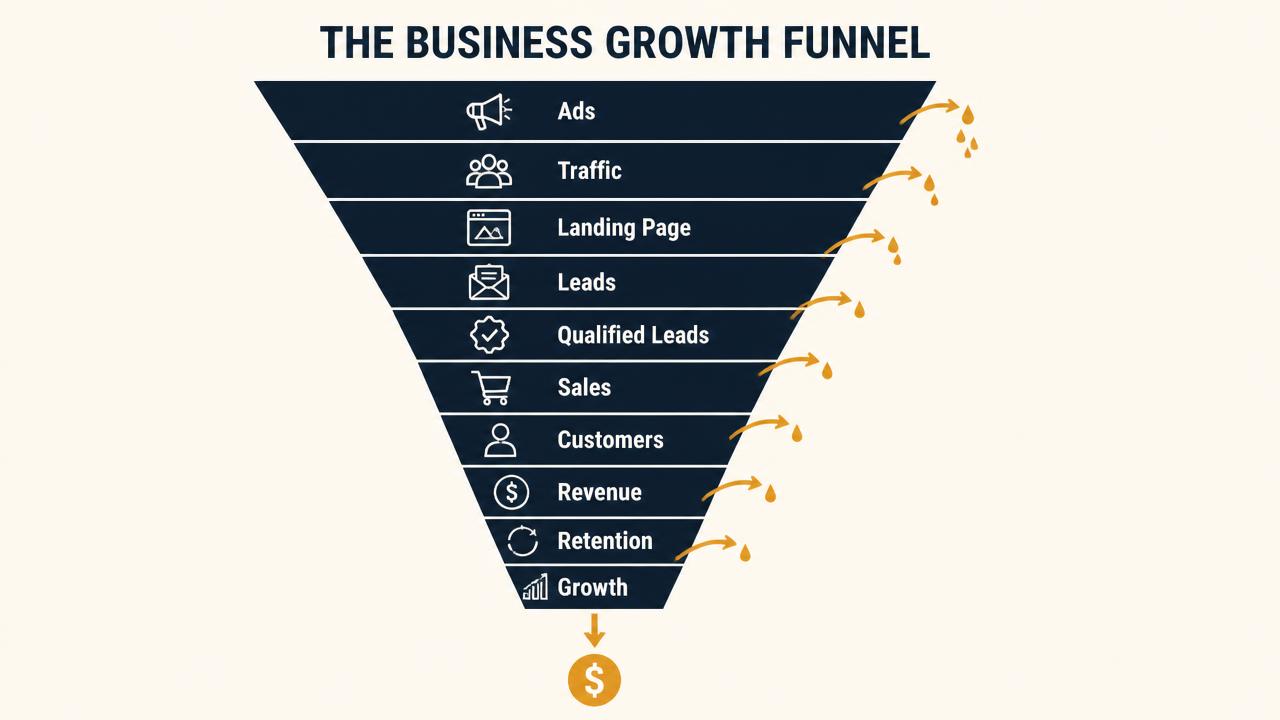
If the full build sequence is what you need rather than a diagnosis, the guide on how to build a profitable performance marketing funnel walks through the complete customer journey stage by stage.
The 10 questions every business should ask before blaming their ads
If you cannot answer one of these with a number, that is where your reporting stops — and almost certainly where your growth problem is hiding.
- 01 Are we attracting the right audience?
- 02 Do visitors understand our offer within a few seconds?
- 03 Does our landing page convert at a rate we have actually measured?
- 04 Are the leads genuinely qualified against a written definition?
- 05 How quickly do we contact a new lead?
- 06 How many leads become real sales conversations?
- 07 How many conversations become customers?
- 08 What does it cost us to acquire one customer?
- 09 Is that customer profitable after delivery costs?
- 10 Do customers come back or refer anyone?
The metrics that actually connect ads to business growth
Marketing performance is measured at four levels. Most reporting stops at level two, which is precisely why a campaign can look successful while the business stands still.
LEVEL 1
Advertising metrics
Impressions · Clicks · CTR · CPC
These describe the auction and the creative. They tell you the campaign is functioning, nothing more.
LEVEL 2
Lead metrics
Leads · Conversion rate · Cost per lead
Most reporting stops here. This is the level at which a campaign can look excellent while the business feels nothing.
LEVEL 3
Quality and sales metrics
Qualified leads · Cost per qualified lead · Opportunities · Lead-to-sale rate
This is where marketing and sales finally use the same numbers, and where poor quality becomes visible.
LEVEL 4
Business metrics
Customers · CAC · Revenue · ROAS · Profit · Lifetime value · Retention
This is the level a business owner actually cares about. Decisions made here are rarely wrong.
The further down the funnel you measure, the closer you get to understanding real business performance.
How marketing and sales should work together
Performance marketing cannot operate as a separate department that hands over a list and waits for applause. The most valuable data in the whole system sits with the people making the calls.
Marketing → Leads → Sales → Customer feedback → CRM data → Marketing optimisation
Sales feedback improves almost every lever in the ad account:
- Which keywords and audiences produce people worth calling
- Which creatives set the right expectation before the call
- Which objections should be answered on the landing page instead
- Which offers close and which only attract enquiries
- Which locations, budgets or segments to exclude entirely
Feed that back into the platforms as qualified-lead and closed-sale events, and the bidding starts learning from your customers instead of your form submissions. Setting this up properly is what a conversion tracking consultant in Pune spends most of their time on.
How to fix the problem without automatically increasing your ad budget
Almost none of these cost media money. Most of them will reduce your lead count and increase your customer count.
Audit your entire funnel, not just the ad account
Write down every stage from impression to repeat purchase and put a number next to each one. The stage where the drop is steepest relative to what you would expect is where your money is going. Most businesses discover the problem is two or three stages past the part they were optimising.
Track qualified leads, not just leads
Agree a written definition of a qualified lead with whoever makes the calls: location, budget range, requirement, timeline. Mark every lead against it. Within a few weeks you will know which campaigns, keywords and creatives produce people worth speaking to.
Improve sales response time
Measure the gap between form submission and first genuine contact attempt. Make it a number someone owns. An automatic WhatsApp or SMS acknowledgement within a minute, followed by a real call quickly, changes contactability more than any bid adjustment will.
Improve the landing page before the budget
Match the headline to the ad, put the offer and its price framing above the fold, cut every link that is not the action you want, make the form short but qualifying, and check the page on a mid-range Android phone on mobile data rather than office wi-fi.
Review your offer honestly
Compare it side by side with the three competitors your customers also contacted. If the only difference is your logo, the campaign is being asked to solve a positioning problem. Clarity, risk reduction and a concrete next step usually beat a discount.
Connect CRM and advertising data
Push qualified-lead and closed-sale events back into Google Ads and Meta through offline conversion imports or the conversions API. This is the single change that moves bidding from chasing form fills to chasing customers, and it costs media budget nothing.
Identify your best customers
Look at who bought, what they bought, what they were worth and where they came from. That profile should drive your targeting, your audiences, your creative and your exclusions. Most accounts are targeting an assumption rather than a customer list.
Optimise campaigns for business outcomes
Once qualified leads or sales flow back into the platforms, switch the optimisation target. Expect lead volume to fall and cost per lead to rise. Judge the change on customers and revenue, not on the metrics it was designed to move away from.
Improve retention alongside acquisition
A repeat customer costs nothing in media. Onboarding, service quality, follow-up after delivery and a reason to return all raise lifetime value, which in turn raises the acquisition cost you can afford to pay. Retention is a growth lever disguised as an operations task.
Review profitability before scaling
Work out profit per customer after delivery, sales and management costs. If it is thin, scaling multiplies a thin margin into a thin margin with more risk. If it is healthy and stable, you have earned the right to spend more.
When should you actually increase ad spend?
Increasing budget is the right decision when the system is ready to convert the extra demand. Use these as entry conditions rather than hopes:
- The funnel converts at a consistent rate over several weeks, not one good month
- Lead quality holds steady when volume increases slightly
- Sales have the capacity to contact every lead quickly
- Customer acquisition cost is comfortably below profit per customer
- Tracking is reliable enough that you trust the numbers you are reading
- The business can deliver the extra work without hurting service quality
When those hold, scale in steps rather than jumps, and watch lead quality and cost per customer rather than lead volume. Costs usually rise as you widen — the question is whether the customers you add are still profitable, not whether CPL held steady.
The final truth: ads don’t grow businesses alone
Advertising can create attention, generate demand, bring qualified visitors and produce leads. Done well, it does all of that predictably.
What it cannot do is compensate for:
- A weak or undifferentiated offer
- A landing page that loses the visitor
- Follow-up that arrives a day late
- A sales process with no shared definition of a good lead
- A customer experience that prevents anyone returning
- Unit economics that were never going to work at scale
Don’t just ask whether your ads are working. Ask whether your entire system is turning advertising into profitable business growth.
Your ads may be working. The real question is whether everything after the click is working too.
Before spending more on ads, find the leak
I'll review your campaigns, landing page, lead quality, tracking and follow-up, and tell you which stage is capping your growth — in a free 10-minute paid ads audit.
Get a Paid Ads AuditFrequently asked questions
Yes. Ads are responsible for impressions, clicks, traffic and leads. Business growth also depends on your landing page, offer, lead quality, sales follow-up, pricing, delivery and retention. A campaign can hit every advertising target it was set while the stages after the click quietly lose the demand it created.
Related articles
How to Get Recommended by AI Search
A practical, no-guarantees guide to building the clarity, expertise, content, authority and technical access that support discovery across search and AI answers.
Google Ads and AI Search in 2026
AI Search is changing how people express intent and how Google Ads interprets it. A practical guide to campaigns, landing pages, conversion data and qualified growth.
Conversion Tracking for Google Ads & Meta Ads
Most accounts can report lead volume. Very few can say which campaigns produced customers. Here is how to connect ad clicks, leads, qualified leads and revenue.
Want this done for your account?
I run these campaigns for startups, e-commerce brands and local businesses from Pune — across India and the GCC.
Google Ads consultant in Pune
Search, Shopping and PMax managed for qualified leads.
Meta Ads consultant in Pune
Facebook and Instagram campaigns built around offer and creative.
Performance marketing consultant in Pune
Strategy, execution and measurement under one owner.
Google Ads lead generation
Lower cost per qualified lead, not just cheaper clicks.
Conversion tracking consultant in Pune
GA4, GTM, Meta CAPI and offline conversion imports.