
Google Ads AI Max in 2026: How It Works, Benefits, Risks & Best Practices
AI Max changes what you control in a Search campaign. This guide explains how it works, where it helps Indian businesses, where it quietly wastes budget, and how to decide whether to switch it on.
By Nikhil Khachane · Performance marketing consultant, Pune · Google Ads · Published September 2026 · Updated September 2026 · 14 min read

Quick answer: Google Ads AI Max is an AI optimisation layer you switch on inside an existing Search campaign. It widens how Google matches your ads to searches, adapts ad text to the query, and can choose a more relevant landing page on your site. It can uncover converting demand your keyword list missed — but it also removes some of the control you relied on, so conversion tracking, negative keywords, exclusions and search term reviews matter more, not less.
Every Indian advertiser I speak to in 2026 asks a version of the same question: should I let Google’s AI decide who sees my Search ads? AI Max is the current answer to that question, and it deserves a straight assessment rather than either hype or panic.
This guide is written from the seat of someone managing accounts, not summarising a press release. Where a claim comes from Google’s own documentation I say so; everything else is practical recommendation or opinion based on how these automation shifts have played out in accounts before.
What is Google Ads AI Max?
Google Ads AI Max is a set of AI-driven targeting and creative features that runs as an optimisation layer inside your existing Search campaigns. Google describes it as a suite that refines targeting and creative delivery in real time rather than as a new campaign type, and it is enabled at campaign level in the campaign settings.
Google introduced it for a simple reason: keyword lists no longer describe how people search. Queries are longer, more conversational and increasingly shaped by AI-assisted search experiences. A keyword-by-keyword account structure was built for a search box people typed three words into.
AI Max is the paid-search implementation layer. Businesses planning the wider organic discovery side can use the guide to improving AI search visibility through SEO, AEO and GEO, which keeps recommendation claims separate from documented search principles.
Before you enable it, three things are worth understanding:
- Your keywords still exist. AI Max adds matching around them; it does not delete your targeting.
- Some settings default to on. Final URL expansion is enabled by default when you opt in, and you can uncheck it during setup or later in settings.
- You may get it without asking. Google has said campaigns using text customization — formerly automatically created assets — are being upgraded to AI Max from September 2026, so check your campaign settings rather than assuming nothing has changed.
Why Google Ads is moving toward AI-powered search
For a business owner, the shift is easiest to understand like this: advertising used to be about guessing the words your customer would type. Now it is about describing your business, your offer and your ideal outcome accurately enough that a machine can find those customers for you.
That trade has a cost and a benefit. The benefit is reach into demand you could never have listed manually. The cost is that your inputs — conversion data, landing pages, exclusions — now determine quality far more than your keyword craft does. Advertisers who treat automation as an excuse to stop paying attention get poor results. Advertisers who treat it as a reason to fix their measurement usually do well.
How Google Ads AI Max works
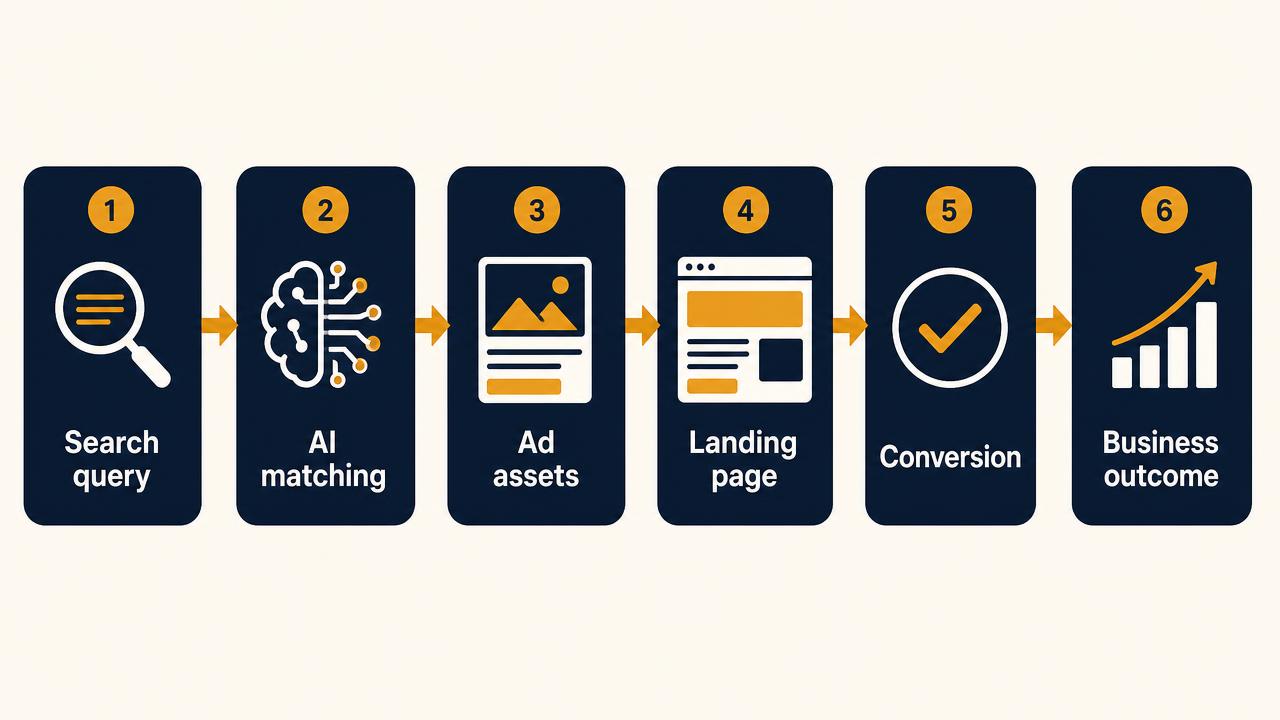
AI Max operates across four connected areas: how searches are matched, how ad text is assembled, which landing page receives the click, and how intent signals feed all three.
Search term matching
AI Max can match your ads to relevant queries beyond your keyword list, using your keywords, ad content and landing pages as context for what your business sells. In practice this surfaces phrasing you would not have added: regional spellings, Hinglish phrasing, problem-first questions and long conversational queries.
Text customization and ad assets
Text customization lets Google generate and adapt headline and description text based on the query and your landing pages. Google notes that this setting was previously called automatically created assets. The practical implication: your landing page copy is now ad copy input, so vague pages produce vague ads.
Final URL expansion
Final URL expansion lets Google send a click to a more relevant page on your domain than the final URL you set, and it is enabled by default when you opt into AI Max. You can turn it off, and you can exclude specific URLs. On a site with well-built service or category pages this is genuinely useful; on a site where most pages are informational, it is a leak.
Search intent and AI
The underlying change is that intent matters more than string matching. Two people can type completely different queries with identical intent, and one person can type your exact keyword with no intent to buy at all. AI Max is optimising for the first pattern. Your job is to make sure it can tell the difference — which it only can if your conversion data reflects real business outcomes.
AI Max vs traditional Search campaigns
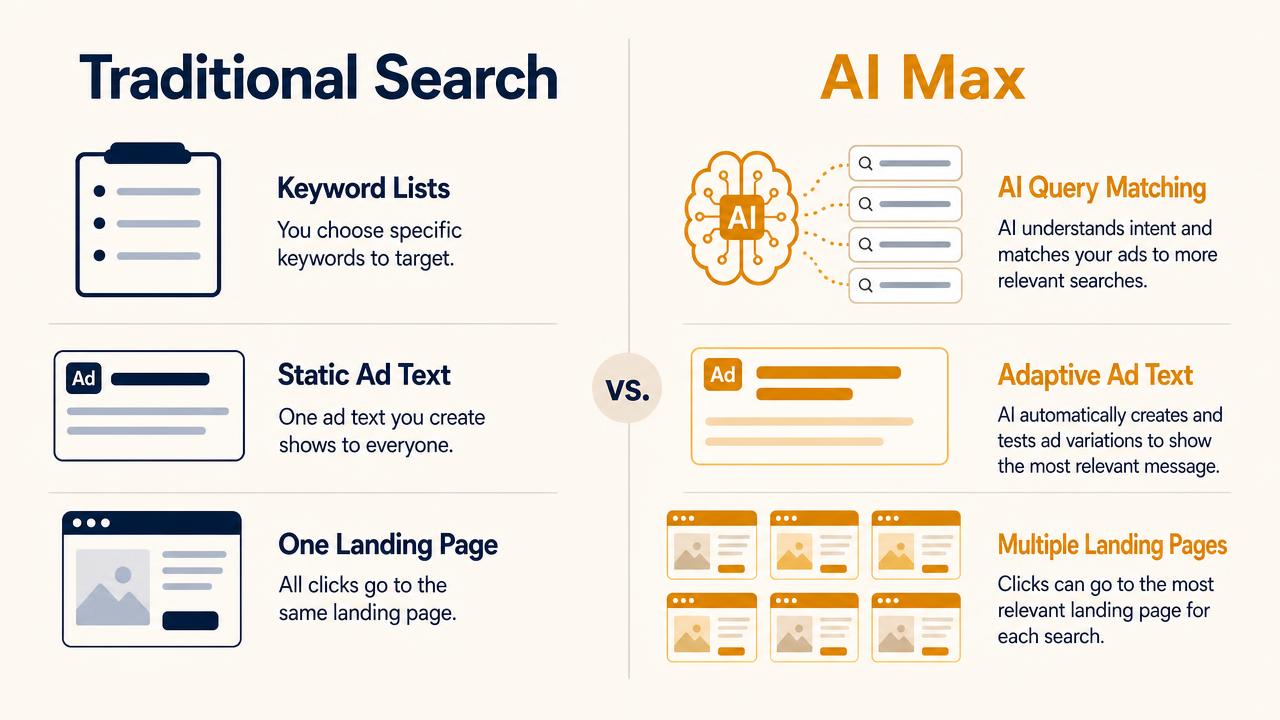
The short version: you trade granular control for reach and adaptivity. The table below is how I explain the trade to clients before we test it.
| Feature | Traditional Search | AI Max | Advertiser control | Potential benefit | Potential risk |
|---|---|---|---|---|---|
| Query matching | Keywords and match types define reach | AI matches relevant queries beyond the keyword list | Lower — steered by negatives and exclusions | Reaches demand you never listed | Irrelevant or research traffic |
| Ad copy | You write every headline and description | Text adapts to the query and landing page | Partial — you set the source assets | More relevant messaging per search | Off-brand or generic phrasing |
| Landing page | One final URL per ad | Expansion can pick a better-fitting page | Lower unless expansion is off or URLs excluded | Better page-to-query fit | Clicks land on weak pages |
| Account maintenance | Keyword expansion and pruning | Search term, negative and page auditing | Different work, not less work | Higher-leverage time use | Neglect shows up faster |
| Diagnosis when results dip | Traceable to keywords and ads | Requires reading terms, pages and quality | Depends on your reporting discipline | Richer signal if you look | Guesswork if you don't |
AI Max vs Dynamic Search Ads
Advertisers who used Dynamic Search Ads will recognise two ideas in AI Max: matching to queries without a keyword for every search, and choosing a landing page automatically. The difference is structural. DSA was a separate ad and targeting type that ran alongside your keyword ads; AI Max is a setting that upgrades the Search campaign you already run.
| Aspect | Dynamic Search Ads (historically) | AI Max (2026) |
|---|---|---|
| Where it lives | A separate dynamic ad group or campaign | A campaign-level setting inside a Search campaign |
| Targeting source | Site pages or page feeds | Keywords, ad content and landing pages combined |
| Ad text | Dynamic headline plus your description | Text customisation across headlines and descriptions |
| Landing page choice | Chosen from your site content | Final URL expansion, on by default and switchable |
| How to think about it | A bolt-on for catalogue coverage | An optimisation layer over your main campaign |
Product availability in this area changes. Verify what your own account offers today before planning a migration, and treat the row above as the shape of the relationship rather than a permanent feature matrix.
What are the benefits of AI Max?
Used on a well-built account, AI Max mainly buys you discovery and relevance. Here is what that looks like in practice.
- Discovery of searches you never listed. Real query language rarely matches a keyword planner. In Indian accounts this is amplified by Hinglish, transliteration and spelling variety — AI matching often surfaces converting phrasing no one would have added manually.
- Ad copy that reflects the query. Text customisation lets the headline shown reflect what the person actually searched, which usually reads more relevant than one static headline serving every query in the ad group.
- Better landing page fit. If your site has genuinely distinct service or category pages, final URL expansion can route a click to the closest match instead of the generic page you set as the final URL.
- Less manual keyword maintenance. Time that went into expanding keyword lists moves to reviewing search terms, negatives and conversion quality — higher-leverage work in most accounts.
- Potential incremental volume. Where demand exists beyond your keyword set, it can add conversions you would not otherwise have reached. Whether those conversions are profitable is a separate question your data has to answer.
Important caveat: AI Max is not automatically better for every account. Whether it helps depends on your conversion tracking, data quality, landing pages, account structure, exclusions, budget, unit economics and how much search demand actually exists for what you sell. Any article promising a guaranteed uplift is selling something.
What are the risks and limitations of AI Max?
This is the section most AI Max articles skip. Each risk below is real, and each one has a mitigation — none of them require abandoning automation.
Less manual control over what you match
You are no longer defining the outer boundary of your targeting with keywords and match types. That boundary is now defined by your negatives, exclusions and the quality of your conversion signal.
Mitigation: Build the boundary deliberately: shared negative keyword lists, brand exclusions where relevant, and a weekly search terms review for the first six to eight weeks.
Irrelevant or low-intent traffic
Broader matching can pull in research queries, job seekers, students looking for free material, DIY searchers and people outside your service area — all expensive if your average order value is modest.
Mitigation: Add negatives for the recurring wasteful patterns in your category before you enable it, not after the budget is spent. Review daily for the first week.
Brand safety and competitor queries
Wider matching can bring your ads into brand or competitor territory you had deliberately avoided, or pull competitor brand traffic you do not want to pay for.
Mitigation: Use brand inclusion or exclusion controls where your account offers them, and keep a dedicated brand campaign so brand performance stays readable separately.
Landing page expansion sending clicks to weak pages
Final URL expansion is only as good as your site. Thin blog posts, outdated offers, out-of-stock categories or a careers page are all technically pages on your domain.
Mitigation: Exclude URLs you never want advertised, and audit the pages the system actually chooses in the landing page report. If most of your site is not sales-ready, keep expansion off.
Poor conversion tracking leads to poor optimisation
Automation optimises toward the signal you give it. Duplicate conversions, page-view conversions or a broken tag will send it confidently in the wrong direction.
Mitigation: Verify tracking end to end before enabling AI Max. This is the single highest-return hour you will spend on the change.
Unsuitable conversion goals
If 'newsletter signup' and 'clicked phone number' sit alongside 'qualified enquiry' as primary conversions, the AI will happily buy the cheapest of the three.
Mitigation: Keep exactly one or two primary conversion actions that represent real business outcomes. Everything else moves to secondary.
Not enough data in small accounts
AI needs conversions to learn from. A campaign generating a handful of conversions a month gives it very little to work with, and results will look erratic.
Mitigation: Consolidate fragmented campaigns first so conversion data pools, or postpone the test until volume supports it.
Harder diagnosis when performance dips
With looser matching there are more possible explanations for a bad month, and advertisers who do not look at search terms and conversion quality end up guessing.
Mitigation: Keep a written baseline and a weekly review rhythm: search terms, landing pages chosen, qualified conversion rate. Change one thing at a time.
Optimising toward the wrong outcome
The most expensive failure is a campaign that hits its cost per lead target beautifully while the sales team closes none of it.
Mitigation: Send closed-won data back into Google through offline conversion imports so the system learns what a good customer looks like, not just what a cheap form fill looks like.
Should Indian businesses use AI Max?
Answer first: test it if your conversion tracking is trustworthy, your campaign produces meaningful conversion volume, and you have someone reviewing search terms weekly. Delay it if any of those three are missing.
Businesses that may benefit
- E-commerce with a wide catalogue — many category and product pages give expansion something useful to choose from.
- Local services with steady enquiry volume — clinics, home services, salons and repair businesses where query language varies enormously.
- Real estate where buyers search by locality, builder, configuration and budget in dozens of phrasings.
- Education — coaching institutes and upskilling brands where course, exam and career-outcome queries multiply endlessly.
- SaaS and professional services with problem-led searches that never fit a tidy keyword list.
- Any account with enough conversion data for the system to learn a real pattern.
Businesses that should be cautious
- Very small budgets. At ₹15,000–₹30,000 a month, broad exploration can consume the entire budget before it learns anything useful.
- Extremely niche products where nearly every adjacent query is the wrong buyer.
- Regulated categories where ad and landing page wording must stay tightly controlled.
- Poor conversion tracking — fix this first; nothing else matters more.
- Weak landing pages, especially where the site is mostly blog content.
- Businesses that cannot absorb irrelevant enquiries, because a small sales team answering unqualified calls is a real cost.
A practical Pune example: a dental clinic spending ₹40,000 a month with call tracking and form tracking in place, targeting a 10 km radius, is a reasonable test candidate. A B2B manufacturer selling one specialised machine to about forty buyers in the country is not — their whole advantage is narrow targeting.
AI Max for lead generation
For lead generation, AI Max only works as well as the definition of “lead” you give it. If every form fill counts equally, you will get more form fills and no more customers.
- Qualified leads over raw leads. Define what qualified means — budget, location, timeline — before you enable anything.
- One or two primary conversion actions. Everything softer becomes secondary so it stops influencing bidding.
- CRM integration. Lead status has to travel back from the sales team, not sit in a spreadsheet.
- Offline conversion imports. The mechanism that tells Google which leads became customers.
- Conversion values. A ₹2 lakh enquiry and a ₹5,000 enquiry should not carry the same weight.
- Lead quality signals. Qualification questions, call duration thresholds and disqualification reasons all sharpen the signal.
This is the same principle behind optimising Google Ads for revenue, not leads. AI Max raises the stakes on it: with looser matching, a lead-count target is a fast route to a full CRM and a flat sales report. If you need the underlying framework first, measuring performance from ad clicks to revenue covers how to connect the two ends. For funnel-level work, Google Ads lead generation is where I do this with clients.
AI Max for e-commerce
E-commerce has the cleanest signal available — actual revenue — which is exactly what makes it a reasonable fit. Product intent varies wildly in phrasing while the outcome stays measurable.
- Send real conversion values, not a flat value per order, so bidding can distinguish a ₹800 order from a ₹12,000 one.
- Work in margin, not revenue. Where you can, pass profit-adjusted values so ROAS reflects what you keep.
- Watch product-level economics. Wider matching can shift the mix toward low-margin bestsellers while total ROAS looks unchanged.
- Exclude the pages that shouldn’t be advertised — out-of-stock categories, policy pages, thin collections.
No honest guarantee exists that AI Max improves ROAS. It changes which auctions you enter; your margins and your site decide whether that change pays.
AI Max for local businesses in India
Local businesses gain the most from query discovery and lose the most from sloppy location control. A few category-specific notes:
- Dentists and clinics: symptom and procedure searches vary hugely. Guard against out-of-area traffic and price-shopping queries you cannot service.
- Real estate: useful for locality, configuration and builder-name variety — provided each project has its own landing page.
- Coaching institutes: strong query discovery, but negatives for “free”, “PDF”, “syllabus” and job-related searches are essential.
- Home services: emergency and same-day intent converts well; enable call tracking before anything else.
- Salons and consultants: small budgets mean tight radius targeting and a genuinely bookable landing page matter more than matching breadth.
None of the location fundamentals change with AI Max: presence-based targeting, excluded areas, a page that loads fast on a mid-range Android phone, and call tracking that actually works. Those are covered in detail in Google Ads for local businesses in India.
How to prepare your Google Ads account before using AI Max
Work through this in order. Most accounts find a problem in the first three steps that would have distorted the whole test.
Audit conversion tracking
Fire a real test conversion on every important action and confirm it appears once — not twice, not never.
Remove irrelevant primary conversions
Anything that is not a genuine business outcome moves to secondary so it stops influencing bidding.
Verify GA4 and Google Tag Manager
Check that tags fire on the right triggers, that consent handling is not blocking them, and that GA4 and Google Ads roughly agree.
Review search terms
Read the last 90 days. The waste patterns you find here become your negative lists.
Build negative keyword lists
Free, jobs, salary, PDF, download, sample, DIY, competitor names — whatever is irrelevant in your category.
Review landing pages
Every page that could be advertised should load fast on mobile, state the offer clearly and have a working enquiry path.
Check location targeting
Set presence-based targeting to the areas you actually serve, and exclude the ones you do not.
Check brand controls and exclusions
Decide up front whether you want brand and competitor queries in this campaign.
Review audience signals
Customer lists, site visitors and high-value segments help AI start closer to the right people.
Connect CRM or offline conversion data
Where the sale happens off-site, plan the import before you switch anything on.
Define the actual business KPI
Cost per qualified lead, CAC or ROAS — decide the number that will settle the argument later.
Establish a baseline
Record 30–90 days of current performance so the comparison afterwards is real rather than remembered.
AI Max conversion tracking: what matters most
The more decisions automation makes, the more your conversion data becomes the strategy. With manual keywords you could rescue a campaign with tight targeting despite mediocre tracking. With AI Max you cannot — the signal is the steering.
- Google Ads conversion actions: one or two primary actions that mean money, everything else secondary.
- GA4: useful for behaviour analysis, but do not let duplicated GA4 imports inflate your Google Ads conversion count.
- Google Tag Manager: check triggers, consent handling and that a real submission fires exactly once.
- CRM: lead status, disqualification reason and deal value flowing back from sales.
- Offline conversions: the closed-won import that teaches the system what a customer looks like.
- Values and revenue: without them, bidding optimises for count, and count is the metric that lies.
If you are not confident this is set up correctly, that is the job to do before AI Max — it is exactly what I handle as a Google Ads conversion tracking consultant in Pune.
How to measure AI Max performance
Answer first: compare qualified conversions, cost per qualified lead and revenue against a pre-AI Max baseline over a period at least as long as your sales cycle. CTR and cost per lead alone should never decide this.
| Metric | Why it matters | What to watch |
|---|---|---|
| Conversions | The raw signal the system optimises toward | A jump with no revenue change usually means quality dropped |
| Qualified conversions | The only lead count that reflects sellable demand | Have sales mark quality weekly, not monthly |
| Conversion rate | Shows whether new traffic matches your offer | A falling rate alongside rising clicks signals loose matching |
| CPA | Cost of one tracked conversion | Compare to your pre-AI Max baseline, not to a benchmark |
| CPQL | Cost per qualified lead — the honest lead metric | Rising CPQL with flat CPA means you are buying junk cheaply |
| CAC | Full cost of acquiring a paying customer | Must sit comfortably below customer value |
| Conversion value | Lets bidding chase value, not volume | Values must be maintained or they mislead |
| ROAS | Revenue against ad spend | Read against margin; a 4x ROAS on thin margins can lose money |
| Revenue and profit | The outcome the business actually cares about | Check monthly against spend, not per campaign per day |
| Search term quality | Direct read on how well matching is behaving | Score a sample of terms as relevant / borderline / waste |
| Lead-to-sale rate | Connects ad spend to the sales floor | A drop here often precedes a revenue drop by weeks |
AI Max optimisation checklist
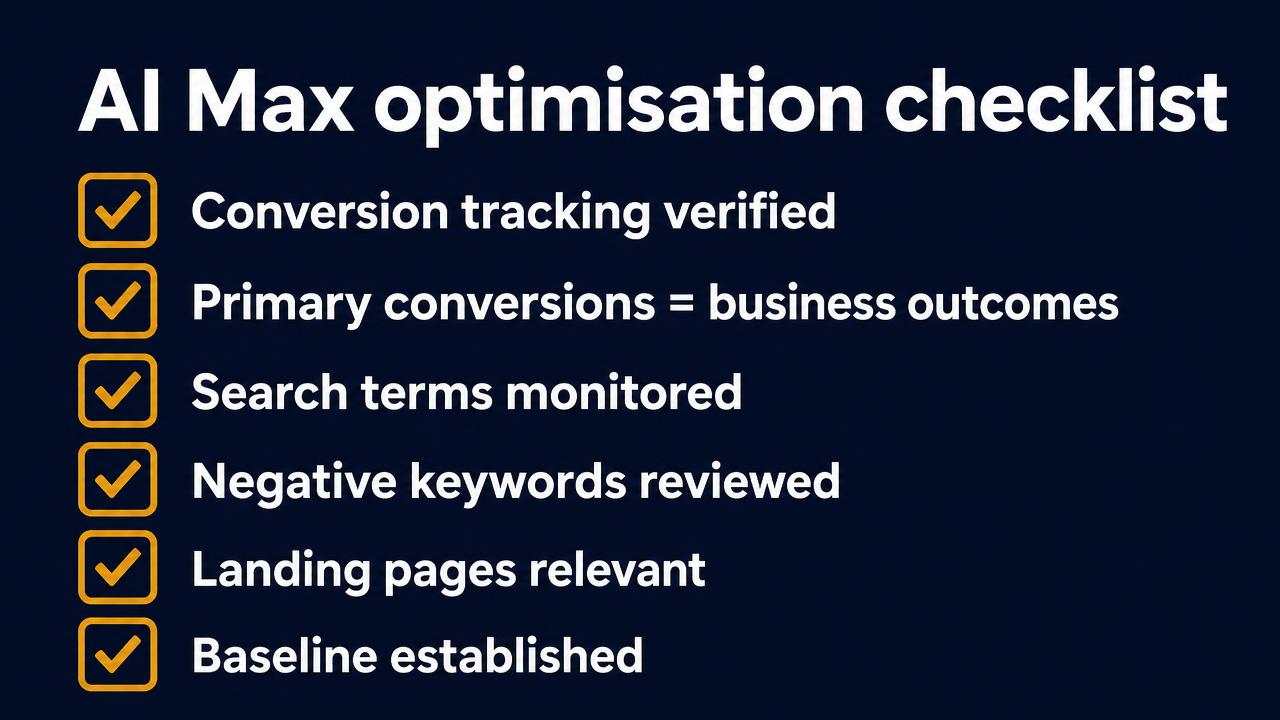
Screenshot this one and run it before every review.
- Conversion tracking verified end to end
- Primary conversions represent business outcomes
- Search terms reviewed weekly
- Negative keyword lists updated
- Landing pages relevant and mobile-fast
- Location targeting set to presence, exclusions added
- Budget sufficient for a genuine test window
- CRM or offline conversion data connected
- Conversion values and revenue tracking configured
- Performance compared against a reliable baseline
Common Google Ads AI Max mistakes
Turning it on without verified conversion tracking
You are handing the steering wheel to a system reading a broken instrument panel.
Optimising for the cheapest possible lead
Cheap leads are easy to buy in India and expensive to work through. Optimise for qualified enquiries.
Never reading the search terms report
This is the one report that tells you whether wider matching is working. Weekly, not quarterly.
Sending traffic to a generic homepage
Broader matching plus one generic page equals a lower conversion rate almost every time.
Judging success on CTR
A higher CTR from adaptive ad text says nothing about whether the business made money.
Judging success on CPL alone
Cost per lead ignores lead quality, which is exactly what changes when matching widens.
Changing strategy every few days
Bidding needs a stable learning period. Constant edits reset it and destroy your comparison.
Ignoring negatives and exclusions
With looser matching, negatives are your steering. Skipping them is not 'letting AI work'.
Feeding low-quality conversion signals
Every soft action marked primary teaches the system to buy more of the wrong thing.
Expecting AI to fix a broken funnel
Slow follow-up, weak offers and poor pages are not targeting problems and no automation solves them.
Testing without a baseline
Without before-and-after numbers, the review turns into opinion.
Comparing across different seasons
Festive, exam and property cycles move Indian demand hard. Compare like with like.
Google Ads AI Max best practices for 2026
- Enable it on one campaign that already converts, not across the whole account at once.
- Keep your best-performing exact-match campaign untouched as a control while you test.
- Keep one or two primary conversion actions that represent real business outcomes.
- Turn final URL expansion off if only one or two pages on your site are genuinely sales-ready.
- Exclude URLs — careers, policy pages, thin blog posts — you never want an ad pointing at.
- Review search terms weekly for six to eight weeks, then fortnightly.
- Maintain shared negative lists at account level so every campaign benefits from what you learn.
- Feed CRM or offline conversion data back in so quality, not volume, drives bidding.
- Give the test a window at least as long as your sales cycle before judging it.
- Write down the decision rule before you start: what result makes you keep it, and what makes you switch it off.
If you want a second pair of eyes on the structure before testing, that is the sort of work I do as a Google Ads consultant in Pune.
Is Google Ads AI Max worth trying in 2026?
For many accounts, yes — as a controlled test, not a wholesale switch. For others, testing it now would only spend money proving that the tracking is broken.
Use it when
- Conversion tracking is verified and trusted by the business, not just by the tag.
- You know which conversions represent revenue and which are noise.
- The campaign generates enough conversions for the system to learn from.
- Your landing pages are genuinely sales-ready.
- Someone will look at search terms and quality every week.
Be cautious when
- Tracking is unreliable or duplicated.
- The budget is too small to absorb an exploration phase.
- Primary conversion actions include soft or vanity events.
- Search demand for your product is genuinely narrow.
- Irrelevant enquiries carry a heavy cost for your team.
Google Ads features and availability can change. This guide was reviewed against current Google information at the time of publication in September 2026 — confirm the settings in your own account before making changes.
Frequently asked questions about Google Ads AI Max
AI Max is an optimisation layer inside Google Search campaigns, not a separate campaign type. When you switch it on, Google uses AI to match your ads to additional relevant searches, adapt the ad text to the query, and — if final URL expansion stays enabled — send clicks to the page on your site that best fits the search.
Sources and references
- About AI Max for Search campaigns — Google Ads Help
- How AI Max for Search campaigns works — Google Ads Help
- Set up AI Max for Search campaigns — Google Ads Help
- About Final URL expansion in Search — Google Ads Help
- About text customization in Search campaigns — Google Ads Help
For the wider strategic context beyond this feature, read how AI Search is changing Google Ads, landing pages and conversion data in 2026.
Want your Google Ads account reviewed before you enable AI Max?
I’ll check your conversion tracking, search terms, negatives and landing pages and tell you honestly whether AI Max is a good bet for your account right now — no pitch, no obligation.
Get a Free 10-Minute Paid Ads AuditRelated articles
Google Ads vs Meta Ads for Lead Generation
One captures demand that already exists, the other creates it. A practical comparison across intent, lead quality, cost, B2B, e-commerce and local business — plus when to run both.
Optimize Google Ads for Revenue, Not Leads
Why lead volume is a vanity metric in India, and the 7-step sequence to move your account from CPL to CRM-connected value-based bidding.
Google Ads for Local Businesses in India
How to advertise on Google in India, location-based targeting strategies, local search intent, negative keywords and conversion tracking — the practical playbook for local Google Ads.
Want this done for your account?
I run these campaigns for startups, e-commerce brands and local businesses from Pune — across India and the GCC.
Google Ads consultant in Pune
Search, Shopping and PMax managed for qualified leads.
Meta Ads consultant in Pune
Facebook and Instagram campaigns built around offer and creative.
Performance marketing consultant in Pune
Strategy, execution and measurement under one owner.
Google Ads lead generation
Lower cost per qualified lead, not just cheaper clicks.
Conversion tracking consultant in Pune
GA4, GTM, Meta CAPI and offline conversion imports.